

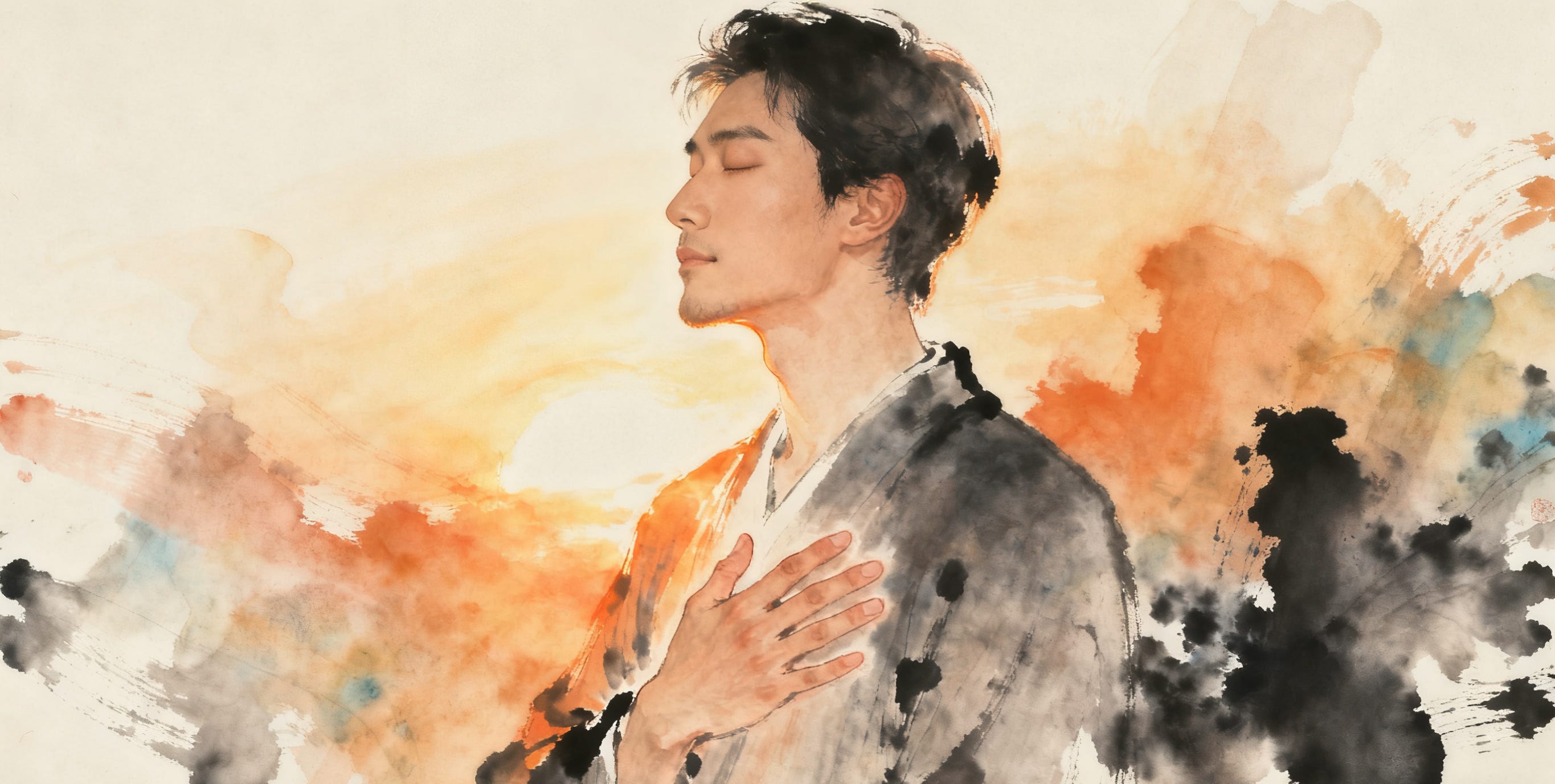
For a long time, I wished I had a different life.
At first, the fantasy was money and status. When you’re young, that’s the mainstream dream, and people tell you it’s the best.
Then the dream upgraded. Not just money, but freedom. The modern version of high status is “I don’t have to work that much, but I still make money,” and it’s framed as the superior life. Looking back, it spoke directly to my ego mind.
Later, another desire rose that looked more noble.
I started to believe the highest habit a human can have is spiritual happiness, the kind that doesn’t depend on conditions. So I began to envy people who could meditate all day, go on retreats, practice for long hours, and live simply.
In a word, I wanted to be free from worldly friction.
Because I live in China, that wish carried extra weight. China is a very secular society. Yes, we have temples, but going on retreat often requires connections, and a retreat lifestyle is not culturally mainstream. It can create friction with family and society.
I also have a full-time job, and in China you don’t have that many days off. Europeans can get a month of paid leave, but many people here can’t.
For me, after working ten years, I might have something like ten days of annual leave, and those days are usually used for family travel, taking care of parents, and handling real life.
So the “ideal practice lifestyle” felt out of reach.
I carried a belief that to progress well in meditation, to reach happiness independent of conditions, I needed retreats, long practice hours, and fewer worldly responsibilities. I thought spiritual progress required a different life.
Now I see something deeper was going on underneath that belief.
The Hidden Engine: A Sense of Lack
Under all these aspirations was a subtle assumption:this moment is not good enough, this life is lacking.
In the beginning, I felt I lacked money and status. Later, I felt I lacked spiritual achievement and an ideal life circumstance for my practice.
On the surface, these look like totally different goals. But the emotional engine underneath is the same: a sense of lack. It says, “What the present moment offers is not enough to help me achieve what I want.”
And what did I want beneath everything?
Lasting happiness.
Two Paths People Take Toward Lasting Happiness
Most of the world chases lasting happiness in two broad ways.
Path 1: Shape your life situation to feel happy
This is the normal path: money, status, relationships, success, comfort. You believe happiness is supported by external conditions, so you try to shape those conditions into something “right.” When it works, it feels like relief.
But the problem is impermanence. Money can disappear. Health can collapse. Relationships can change. Accidents happen. People we love die, and we don’t get to vote on it.
I still remember how shocked I was when Kobe Bryant died in a helicopter accident. Nobody expects that. If someone’s happiness depends on a person being alive, then their happiness can be destroyed in one phone call.
So even if you build a good life, you often have to rebuild it again and again. The world doesn’t hold still. That’s why this path is unstable.
Path 2: Uncover the happiness that’s already in you
This is the spiritual path, and the fundamental assumption is different. Here, happiness is already in you, and it doesn’t need to be manufactured. It needs to be uncovered.
The first path is like believing the sky is always dark, so you must manufacture an artificial sun and hang it up there, then keep feeding it energy. The second path is like believing the sun has been behind the clouds the whole time, and your work is to remove the clouds.
This is the deeper difference between secular striving and spiritual practice. It’s also why stories like The Alchemist resonate so much. The boy travels the world searching for treasure, only to find it right where he started, under the ground.
It’s a metaphor: what you’re looking for is closer than you think.
When Spiritual Practice Becomes Another Form of Escaping
Here’s the uncomfortable part. My desire for the “ideal spiritual life” was not always pure. Sometimes it was sincere longing, but sometimes it was also a subtle form of escape.
I wanted a retreat lifestyle partly because it reduces triggers. If I’m away from work stress, family friction, social pressure, and modern chaos, then fewer unpleasant feelings rise. But those triggers are still embedded in me.
So the wish to constantly retreat can become spiritual bypassing.
It’s the same pattern as the worldly path, just dressed in spiritual clothing. Money and status bypassing. Relationship bypassing. Freedom bypassing. And then spiritual bypassing. In all cases, the hidden belief is the same: “This life as it is is not good enough. I need to shape it into something else so I can finally be okay.”
Even if the goal is unconditional happiness, the path becomes conditional. “If I can meditate X hours a day, if I can retreat Y times a year, if I can find the right master, then I’ll be free.” Do you see the contradiction?
If the goal is unconditional happiness, the path must have the flavor of unconditionality.
The Shift: Using the World to Transcend the World
A paradigm shift happened when I encountered a different model.
I resonated deeply with a teacher named Sayadaw U Tejaniya who went through depression while living a normal secular life surrounded by chaos, responsibilities, and work.
He didn’t have ideal conditions, and he didn’t wait for ideal conditions.
He emphasized something simple and fierce: practice moment-to-moment awareness in daily life. Not just on the cushion. Not just in retreat. Daily life.
He said retreats can help you learn how to meditate, but the important thing is practicing in real life. People go to a retreat, their mindfulness improves from level 1 to level 8 (let’s say 10 is the top), then they go back to life and stop practicing, and they slide back down to 1 again.
That hit me.
Because it suggested something radical.
Maybe the path is not leaving the world to transcend the world. Maybe the path is using the world to transcend the world.
This is not a new idea. In Buddhism, there’s a line often translated as:“Afflictions are not other than awakening.” What we want to escape in daily life is affliction. That’s why people chase money. That’s why people chase enlightenment.
But if afflictions are not other than awakening, then the thing you want to escape might be the doorway you need.
There are powerful examples of this.
In the Vimalakirti Sutra, Vimalakirti is a lay person, yet portrayed as deeply awakened, sometimes beyond monks around the Buddha.
U Ba Khin was a lay Buddhist working in government under ministers, politics, deadlines, power structures, and stress, and still practiced continuously.
Michael Singer, a businessman, programmer and spiritual teacher, advocates not immediately changing your life situation, but noticing what your job triggers and surrendering that inner reaction as purification.
They didn’t escape life. They used life.
Why Daily Life Is the Ultimate Litmus Test
Unconditional happiness is often described as “transcending the world.” But how do you know whether you’ve transcended the world? If you only feel peaceful in a retreat center, is that transcendence?
If you become calm in a monastery, then return to normal life and get triggered again and again, what has actually changed? The real world is the test. One of the best measures of spiritual progress is very simple: do the same triggers still hook you?
I’ve heard stories of mindfulness practitioners who realized their practice had matured when they met someone who used to embarrass them, and the embarrassment simply wasn’t there anymore.
No suppression. No pretending. Just nothing to defend. That’s purification, and daily life gives you endless tests.
That’s a gift.
The Fighter Metaphor: Training Time vs Match Time
Here’s a metaphor that makes this vivid. Imagine you are a fighter. You have training time, and you have match time.
For some people, retreat life gives them a lot of training time. They can practice long hours in controlled conditions. For many of us, secular life is mostly match time.
You’re thrown into real fights before you feel ready. Opponents appear randomly. Some are weaker, some are stronger. The timing is not in your control, and the interval between fights is not in your control either.
Training time is your cushion practice, your meditation time, your retreat time. Match time is daily life: stress, conflict, power struggles, deadlines, family friction, sickness, accidents, and loss.
If you sincerely use match time to grow, you can progress extremely fast. But only if you fight the right way. Not with aggression. Not with avoidance. But with sincere practice.
The Core Principle: If the Goal Is Unconditional, the Path Must Be Unconditional
This insight rewired me. If you’re trying to reach unconditional happiness by shaping conditions, you’re walking in contradiction. You’re trying to purchase the unconditional with conditions.
So the path has to shift.
This life is the practice.
A Practical Map: Four Categories of Daily Experience
To make this workable, I like dividing life into four categories: neutral, pleasant, unpleasant, and mixed. In any given moment, one category is usually dominant. Each category has its own training emphasis.
1) Neutral moments: observe without judgment
Neutral moments are everywhere. Drinking water. Sitting on the toilet. Waiting. Walking. Small talk. Repetitive tasks. These moments are not dead time.
They are practice time.
The technique is simple. Notice what you see, hear, and feel in the present moment. Just observe. This is baseline mindfulness, and it quietly builds stability.
2) Pleasant moments: enjoy
When something pleasant happens, the mind often sabotages it. You achieve something, then instantly think, “I still have six more to go.” You’re with family, but worry about work. You’re finally resting, but think of the future.
Pleasant moments train one skill: enjoy.
Let the enjoyment be full. Celebrate. Savor. This isn’t shallow, it’s training. It teaches the nervous system that goodness can be received without grasping.
3) Unpleasant moments: surrender
This is the big one, because this is where purification happens.
A remark triggers anger. News triggers grief. A memory triggers shame. A craving rises. The urge to doomscroll appears. The urge to drink appears. The mind attacks you with “not good enough.”
These moments are the real opponents.
The technique is surrender.
Deconstruct the experience into See (images), Hear (inner talk), and Feel (body sensations). Then place your loyalty on the body sensations and let thoughts and images pass like weather.
I like the floating metaphor here. When you float on water, waves hit you. Sometimes your nose goes under for a moment, but if you relax, you float. If you struggle, you sink.
Unpleasant experience is like waves.
The more you surrender to unpleasantness, the more the unpleasant energy will dissipate; the more you drop the sandbags tied to your hot air balloon, the more naturally you will rise.
4) Mixed moments: adapt
Many moments are mixed. For example, you’re with your child feeling joy, and you also worry about your father in the hospital. Mixed moments require flexibility and judgment.
Sometimes you hold both. Sometimes you focus on joy while allowing worry in the background, because you can’t take action in that moment anyway. Later, when action is possible, you might turn toward the worry, surrender it, and let the system release.
Either way, it’s all practice.
Why This Works: The Three Attention Skills
In Unified Mindfulness language, the whole path trains three attention skills: concentration, sensory clarity, and equanimity. Concentration is choosing what to focus on. Sensory clarity is noticing details clearly. Equanimity is allowing experience to come and go without grasping or resisting.
When these three skills mature, unconditional happiness begins to show itself more and more. That’s why practicing across all four categories matters in every waking moment. You’re training these skills all day, not just during meditation.
This is also why a monk who sits all day but daydreams can stagnate. And a lay person in the world who practices continuously can progress rapidly.
Continuous practice wins, regardless of what your life situation is.
Devotion and Renunciation: A Different Definition
In spiritual language, devotion and renunciation are often emphasized. People assume a monk has more renunciation because he renounces the world. But there is another way to define renunciation.
Renunciation is not leaving the world. Renunciation is leaving the belief that the world can provide lasting happiness. It’s renouncing the attachment to manipulating life conditions to feel okay.
You can be fully engaged in work, family, money, and responsibility, and still live in the world but not of it. And what is devotion? Devotion is what you do when you are not sleeping.
A businessman devotes himself to money by thinking about it constantly. A spiritual practitioner devotes himself to practice by applying continuous awareness across neutral, pleasant, unpleasant, and mixed moments.
If you do that, your daily life becomes your meditation hall.
Your Koan Is Life Itself
Zen uses koans. A koan is not something you solve with intellect, it’s something you live into until realization ripens.
In this path, your koan is simple: can you be at peace with whatever life throws at you? Frustration, anger, loss, chaos, cravings, guilt, fear, pressure. Can you meet it with clarity and equanimity? Can you enjoy the pleasant without grasping, observe the neutral without spacing out, and adapt wisely in mixed moments?
Life keeps asking the question. You keep practicing. One day, something opens.
The Giant Meditation Hall With No Roof
A monastery meditation hall has a roof. Your daily life doesn’t. Your practice space is exposed: work stress, family needs, unpredictable problems, bad news, illness, time pressure.
But that roofless hall might be the greatest training ground you could ever ask for. Because if the goal is to transcend the world, then why not use the world to transcend the world?
A Closing Reflection
If you relate to the feeling of “I need a different life to practice,” I understand. I lived there. But it may be worth asking whether that desire comes from sincere devotion, or whether it also comes from a subtle sense of lack, a belief that “this moment is not enough for me to progress.”
If the treasure is truly already here, then maybe the path is not escaping life. Maybe the path is learning how to practice inside life, right where you are and right now.
Now I’d Love to Hear From You
Do you secretly believe you need a different life situation to be spiritually free? Which category is hardest for you to practice in: neutral, pleasant, unpleasant, or mixed? And what would change if you treated your daily life as your meditation hall, even without a roof?
Very well written, my friend. I really enjoyed reading this, and agree life is the meditation hall. Thank you for sharing.