

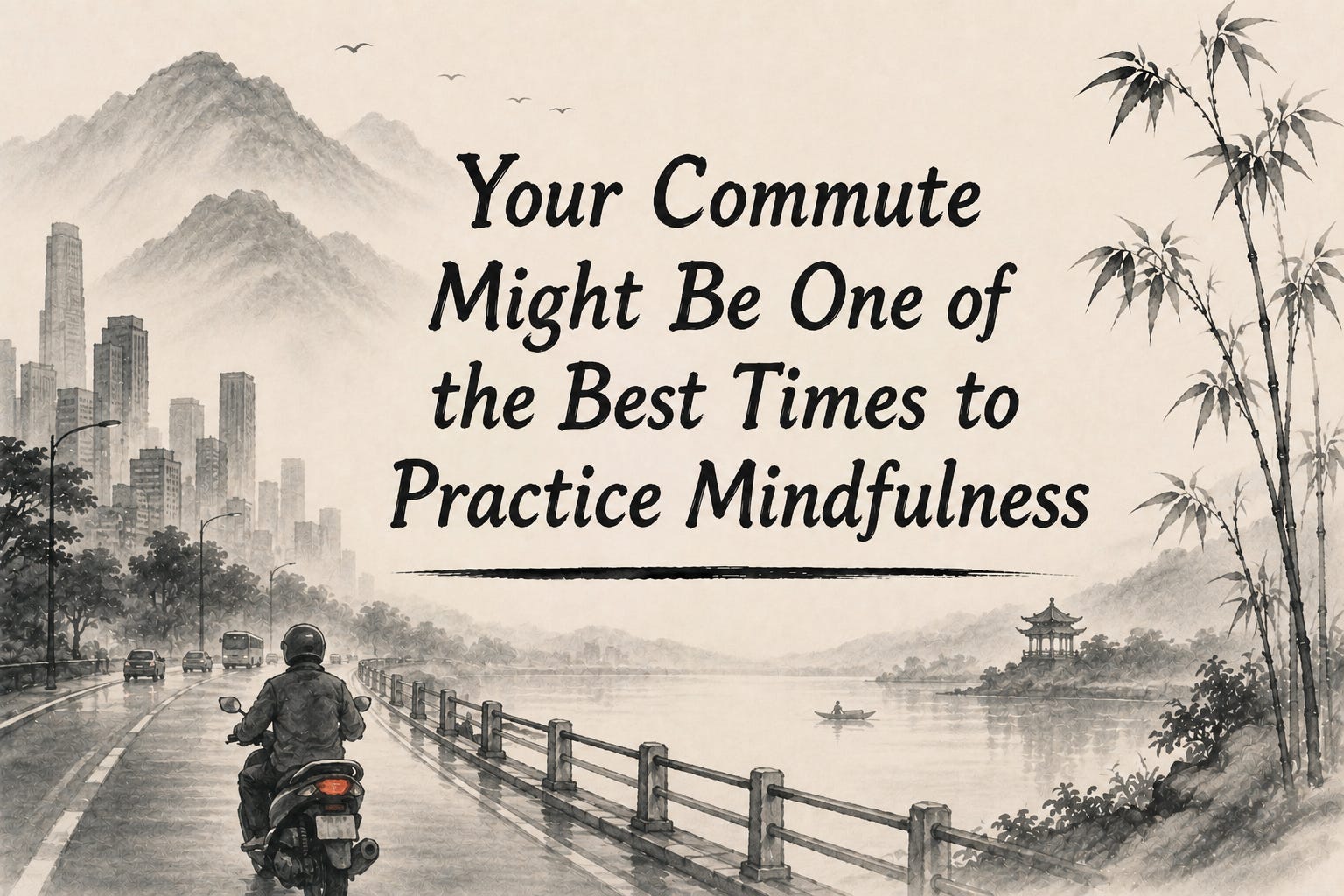
A lot of people tell me they don’t have enough time to meditate.
I completely understand. You wake up and immediately have things to do. Maybe you need to make breakfast, get ready for work, take care of your kids, or maybe you simply went to bed too late and don’t have another thirty minutes in the morning to sit quietly.
But there is one period of the day that many people don’t think of as meditation time: the commute.
If you spend twenty or thirty minutes every day on the subway, bus, or in your car, that’s already a substantial amount of time. And you don’t necessarily need to add anything else to your schedule. You can simply turn some of that existing time into mindfulness practice.
The Subway Can Become Your Meditation Room
Public transportation is probably the easiest place to start because you aren’t responsible for driving. You can give much more of your attention to meditation.
Suppose your subway ride takes twenty minutes. You could spend ten minutes simply observing your breath. You could also do a body scan, moving attention gradually through different areas of the body and noticing whatever sensations are present.
You don’t even have to sit down. Meditation works perfectly well while standing.
In fact, standing on a crowded subway can give you some interesting meditation objects that you wouldn’t have at home. The train moves. Your body adjusts its balance. Someone bumps into you. You feel your feet pressing into the floor or your hand holding the rail. All of these are physical sensations, and all of them can become objects of mindfulness.
In some ways, practicing in a noisy subway may even train your attention more than practicing alone in a quiet room. There are more things competing for your attention, so staying with the breath or the body requires stronger concentration.
Of course, I’m not saying you should replace all formal meditation with subway meditation. But if you already spend thirty minutes commuting every day, why not use some of it?
Driving Can Be Meditation Too
Driving is a little different because safety has to come first. I wouldn’t recommend closing your eyes, becoming absorbed in internal imagery, or doing anything that takes attention away from the road.
But mindfulness doesn’t require you to turn away from the world. You can make driving itself the meditation.
One simple approach is to become much more aware of your visual field. Instead of driving while thinking about yesterday’s meeting or tomorrow’s problems, actually look at the road. Let your attention include the whole visual field rather than staring narrowly at one point.
This may even make you a safer driver. You may notice a pedestrian approaching the road earlier, a car beginning to change lanes, or a scooter or motorcycle appearing from the side.
You can also notice how surprisingly rich the visual experience of driving actually is. Maybe it’s summer and the trees are particularly green. Sunlight is reflecting from the leaves. People are walking along the sidewalk. Cars are constantly entering and leaving your field of vision.
Normally we miss most of this because we’re busy thinking.
When you actually pay attention, an ordinary drive can become surprisingly interesting. You can almost treat the windshield like a movie screen and simply watch the movie unfolding in front of you.
And vision isn’t the only thing available. You can notice the physical sensations involved in driving: your hands touching the steering wheel, the subtle movements in your arms as you turn, your foot pressing the accelerator and then releasing it, or the pressure involved in braking.
You can also hear the sounds of traffic and notice how a vehicle approaches, passes you, and gradually disappears into the distance. None of this requires you to do something extra while driving. You’re simply becoming more aware of the driving you’re already doing.
Traffic Can Also Train Your Equanimity
There is another kind of meditation that driving offers, and this one may be even more valuable.
Someone cuts you off. A car suddenly brakes in front of you. A scooter or motorcycle suddenly moves into your lane. Immediately, irritation arises.
For some people, this becomes road rage. They start swearing, complaining, or mentally attacking the other driver. But if you have some mindfulness practice, that moment can become something completely different.
Notice what irritation actually feels like in the body. Maybe your chest tightens. Maybe your face becomes hot. Maybe your hands grip the steering wheel harder. Instead of immediately following the angry thoughts, stay with the bodily experience for a moment while, of course, keeping enough attention on the road to drive safely.
You don’t have to suppress the anger, and you don’t have to tell yourself that you shouldn’t be angry. Just let the sensations be there and observe them without adding unnecessary resistance.
Then the person who cut you off has accidentally given you a meditation exercise.
You could even say they’re helping you train your temperament.
This is one of the things I find interesting about bringing mindfulness into ordinary life. Experiences that used to be nothing but annoyances can gradually become opportunities to practice Concentration, Sensory Clarity, and Equanimity.
You May Have More Time to Practice Than You Think
When people say, “I don’t have time to meditate,” sometimes what they really mean is, “I don’t have another thirty minutes to sit alone in a quiet room.”
Those are not the same thing.
Formal sitting practice is valuable, and I certainly recommend it. But meditation doesn’t have to happen only on a cushion. If you broaden your definition of where practice can happen, you may discover that your day already contains many opportunities.
Your subway ride can become a body scan. Your walk to work can become walking meditation. Your drive can become an exercise in sensory clarity. Getting cut off in traffic can become equanimity practice.
You don’t necessarily need to find more time.
Sometimes you just need to use the time you already have differently.
I appreciate you taking the time to read this.
If you’re interested in exploring how mindfulness can support daily life, not just on the cushion, but in ordinary moments, I’d be happy to have you here.
Please subscribe and join me.
And, If You’d Like Some Personal Support With Your Mindfulness Practice…
I offer 1:1 mindfulness coaching as a certified Unified Mindfulness teacher/trainer.
The coaching can help you deepen your practice, correct misunderstandings, or better understand how mindfulness works. We will also design ways to bring the practice into your actual daily life, not just your meditation sessions.
If you’re interested, feel free to book a connection call. We can talk about your goals, your current practice, and how mindfulness training might help. We can also see whether working together would be a good fit.
You can send me a DM or email me at miaosimuse@qq.com, and I’ll send you my availability for a call.