

Here is a habit most of us carry without noticing.
We judge.
We scroll through other people’s lives and quietly criticize their choices. We observe someone’s words or behavior and label them as inappropriate, ignorant, or misguided. Even in casual conversation, we find ourselves measuring others against an invisible standard of how life should be lived.
We often tell ourselves this is discernment. That we are simply seeing clearly. That we are separating right from wrong.
And yet there is a simple truth we tend to overlook.
When we fixate on others’ flaws and judge them, the one who actually suffers is us.
It took me a long time to see this clearly.
Judgment is not loud like an argument. It doesn’t always explode outward. Most of the time, it stays inside. Quiet. Repetitive. Turning over and over in the mind.
But that doesn’t make it harmless.
Judgment is a form of inner aggression. It drains energy without resolving anything. It occupies the mind, disrupts emotional balance, and leaves a subtle residue of tension that can linger for hours or even days.
You might recognize the feeling. Nothing dramatic has happened, yet your mind feels cluttered. Heavy. Irritated. Someone else’s behavior has taken up space inside you, and now you’re the one carrying the weight.
I once heard a metaphor that made this painfully clear.
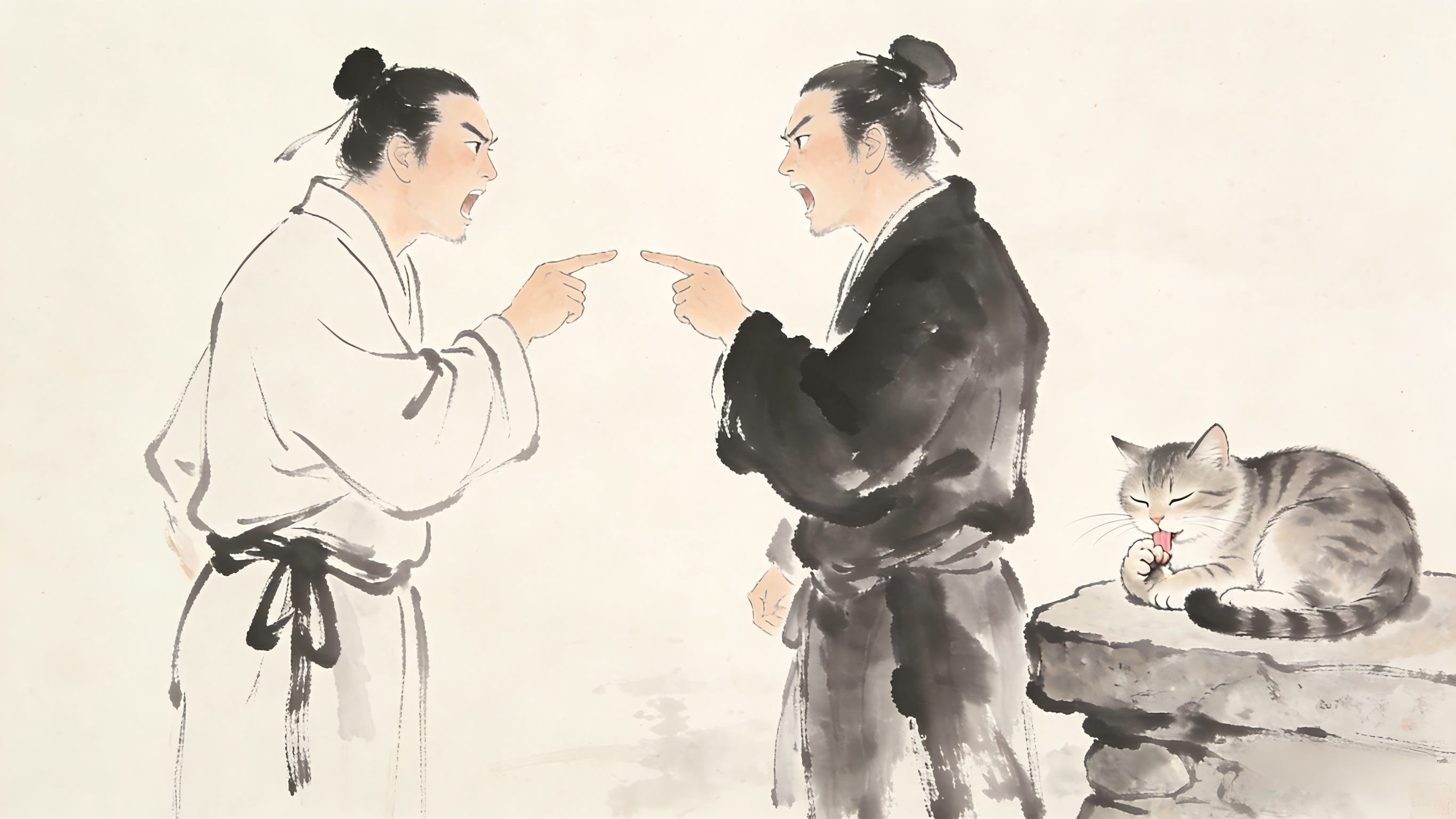
Imagine a stray cat wanders into your backyard. You feel annoyed, convinced it’s making a mess of a space you worked hard to keep clean. Out of irritation, you start throwing trash in its direction, hoping to scare it away.
But no matter how hard you throw, the trash never really lands on the cat. Instead, it scatters across your yard. And when the cat finally leaves, you’re the one left kneeling on the ground, cleaning up the mess you created.
Judgment works the same way.
The negativity you throw rarely reaches its target. It stays with you. It pollutes your inner space. And eventually, you’re the one who has to clean it up.
What makes judgment especially seductive is that it often comes wrapped in a subtle sense of superiority.
When we judge others, there is an unspoken thought underneath it. I see more clearly. I know better. I’m not like them.
This feeling can be strangely satisfying. Like a small dose of sweetness for the ego. It reassures us that we are on the right side of things. That we are more aware, more correct, more evolved.
But this sweetness doesn’t last.
The more we indulge in it, the more restless we become. The sense of calm we think we’re gaining quietly erodes. What remains is irritation, comparison, and a mind that cannot rest.
Some people respond to this by saying, “Fine, I admit judging others doesn’t feel good. But sometimes they really are wrong.”
And that’s true.
There are moments when people act poorly. When their words hurt. When their behavior clashes with our values. Acknowledging this is not the problem.
The deeper question is this.
In our insistence on being right, what are we actually seeking?
Is it the label of correctness?
Or is it inner peace?
Ancient wisdom saw this clearly long before modern psychology. Confucius advised people to be strict with themselves and gentle with others, noting that this was how resentment and conflict gradually faded. What once sounded like moral instruction reveals itself, with age, as practical advice for living with less suffering.
When we obsess over others’ mistakes, we are often being unforgiving toward ourselves as well. We spend precious energy monitoring, evaluating, and reacting instead of attending to our own inner life.
Our attention is limited. When it is consumed by judgment, there is little left for presence, warmth, or appreciation. We become reactive, tense, and easily disturbed. We trap ourselves inside a mental courtroom where arguments never end and no verdict ever brings relief.
Happiness does not live there.
Happiness does not require us to win arguments in our heads or prove that we are more right than someone else. It does not depend on sorting the world neatly into right and wrong.
It begins when we loosen our grip on judgment.
Choosing not to judge does not mean abandoning discernment. It does not mean tolerating harm or pretending everything is acceptable. It means recognizing when judgment has stopped being useful and started being costly.
Not judging others’ choices is not weakness. It is respect.
Not clinging to every debate is not cowardice. It is clarity.
Not feeding a false sense of superiority is not ignorance. It is wisdom.
Letting go of judgment is not about becoming indifferent. It is about redirecting attention back to where it belongs. To your own growth. Your own emotional well-being. Your own capacity for care.
When you stop using others’ shortcomings to punish yourself, something changes. The inner tension begins to dissolve. The mind becomes quieter. The heart feels less armored.
You may notice a gentler quality returning. A sense of space. A kind of ease that had nothing to do with being right and everything to do with being at peace.
In the end, happiness is rarely found in arguments about who is correct. It is found in the freedom that comes after we release the need to judge.
Less judgment.
More understanding.
Less harshness.
More softness.
When we are no longer trapped in the endless weighing of others, we finally have the chance to settle into ourselves.
And in that settling, a quieter, steadier happiness begins to appear.