

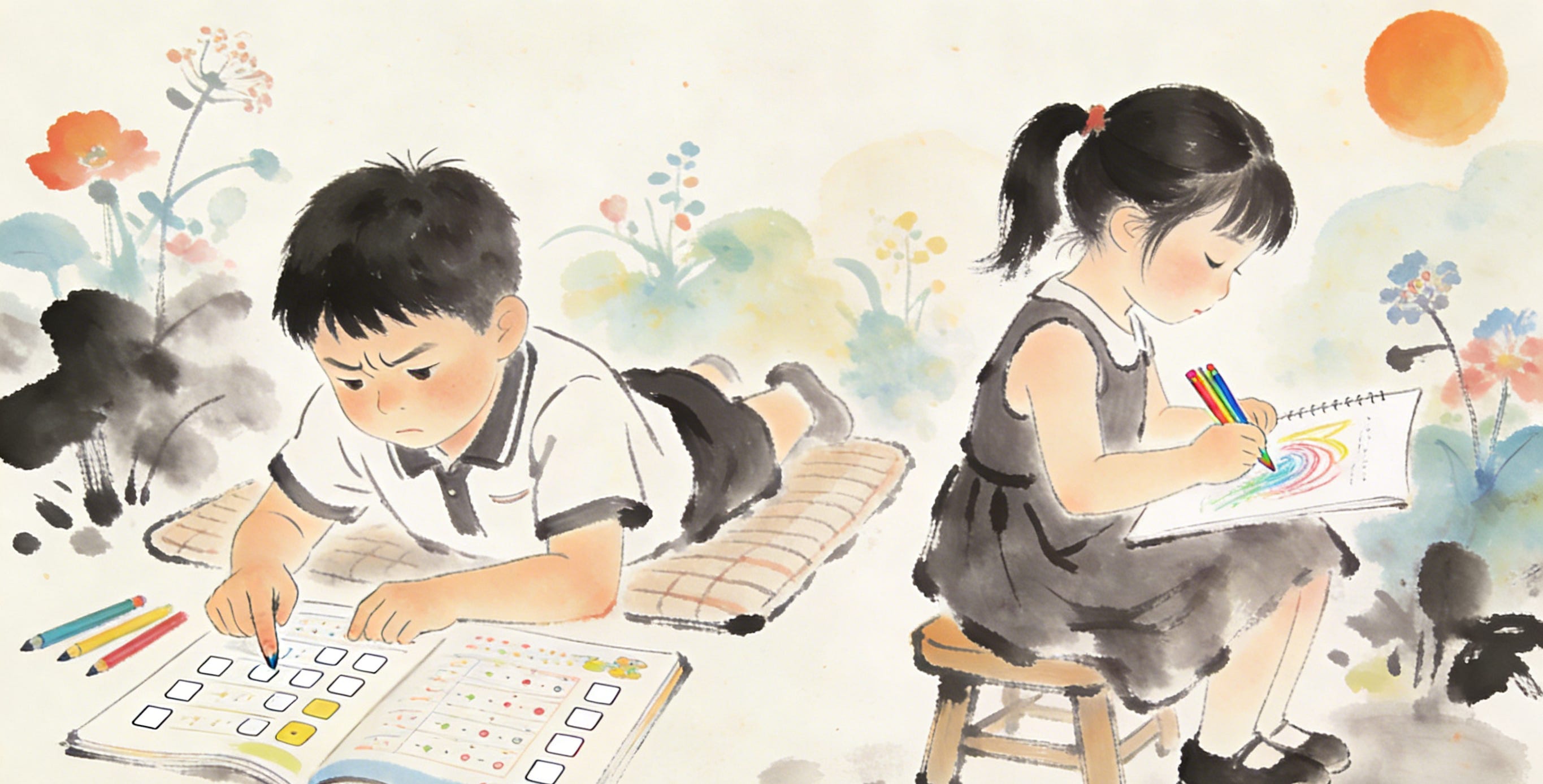
We often live as if life were a standardized exam.
What major should I choose?
What job should I take?
When should I get married?
Should I have children?
At every major life crossroads, we frame our decisions as questions with “correct answers.” Sometimes they feel like single-choice questions, either this or that. Sometimes they feel like multiple-choice questions, where we anxiously compare combinations and optimize for the “best” outcome.
Yet the further we go in life, the clearer something becomes.
Maybe we misunderstood the nature of the question from the very beginning.
Life Was Never a Multiple-Choice Test
I’ve come to see life not as a multiple-choice question, but as an open-ended one.
An open-ended question has no preset correct answer. It doesn’t ask you to select from limited options or to optimize based on external criteria.
It asks for something else entirely.
It asks for a sincere response to what is happening right now.
This perspective aligns deeply with the philosophy of Wang Yangming, who proposed the idea of“the mind itself is principle.”In his view, the truth of things does not need to be hunted down externally. There is no need to chase borrowed standards or universal formulas.
What matters is whether one acts from sincere inner knowing.
Life, in this sense, is not solved by finding the right answer.
It is lived by responding honestly.
Why So Many of Us Feel Anxious
Much of modern anxiety comes from an obsession with choosing correctly.
We fear choosing the wrong major and ruining our future.
We fear choosing the wrong job and wasting our youth.
Some of us even hesitate over something as small as choosing a drink, afraid of picking the wrong flavor and disappointing ourselves.
We pour enormous energy into avoiding mistakes.
Yet we rarely pause to ask deeper questions:
What do I actually want?
What do I feel right now?
What matters to me in this moment?
When life is treated as a test, every decision feels heavy. Every choice seems irreversible. Every alternative becomes a potential regret.
An Open-Ended Question Has No “Wrong Answer”
Here is the quiet truth.
An open-ended question cannot be answered incorrectly.
Someone chooses a so-called “unpopular” major and later finds genuine passion through deep engagement. That isn’t a wrong choice. It is a personal answer.
Someone leaves a stable job to pursue a dream, even if the road is rough and uncertain. That courage itself is a sincere response.
Someone chooses not to marry or have children, at least for now, and instead learns how to live fully on their own. That, too, is responsibility toward one’s life.
As Wang Yangming once said:
“That bit of innate knowing within you is your own true standard.”
When decisions arise from this inner sincerity, they do not need validation from social expectations or external scorecards.
There Is No Universal Grading Rubric
An open-ended question doesn’t require comparison.
You don’t need to measure your answer against someone else’s.
You don’t need to grade yourself according to prevailing standards of success.
Just as open-ended questions don’t have unified scoring rules, life has no single template for success.
What truly matters has never been “choosing correctly.”
It has always been sincerity.
Sincerity toward your inner world
Sincerity in how you respond to each turning point
Sincerity in accepting the consequences of your choices, pleasant or painful
From “Choosing Right” to “Responding Honestly”
When life is treated as a multiple-choice question, fear dominates.
When life is treated as an open-ended question, something shifts.
You stop asking:
“Which option is correct?”
And you start asking:
“How do I want to respond right now?”
You stop fearing that one “wrong choice” will permanently derail your life. You begin to trust that each sincere response becomes part of a story only you can write.
This doesn’t mean life becomes easy or painless. Open-ended questions can be demanding. They require presence, honesty, and responsibility.
You can’t hide behind rules.
You can’t outsource decisions to formulas.
You have to show up.
The Freedom of Not Needing a Final Answer
When you stop treating life like a test you must pass, anxiety loosens its grip.
Freedom expands.
You realize that life was never about arriving at a predetermined solution. It was about participating fully, moment by moment, with integrity.
To respond sincerely to the present is not resignation. It is active engagement.
It means listening inwardly, sensing what feels alive and true, and allowing your actions to emerge from that place.
This is where Wang Yangming’s insight becomes lived reality, not just philosophy.
The mind itself is principle.
A Closing Reflection
Life does not demand that you find the standard answer.
It asks something quieter, yet far more intimate.
Will you respond honestly to what is here?
When you finally stop treating life as a test and start treating it as a conversation, you may discover something unexpected.
There was never a correct answer waiting for you.
There was only this moment,
asking for your most sincere response.