

I used to think mindfulness was something reserved for the cushion.
I sit on my mat and spend 20 minutes trying to stay present. As soon as I stand up and step back into the chaos of daily life, with groceries to buy, emails to answer, and traffic to navigate, I assume my practice is over.
Like many people, I confused “concentration” with “mindfulness.” I believed the only “real” mindfulness happened in a quiet room, free of distractions, where I could sit perfectly still and empty my mind.
The rest of the day? Just life getting in the way of my practice.
But the longer I’ve meditated, the more I’ve realized how backwards that thinking is. Mindfulness isn’t a ritual confined to the cushion. It’s a way of being, one that’s meant to be lived, not just practiced in isolation.
And the messiest, most frustrating moments of daily life? They’re not interruptions to your practice. They are the practice.
The Wisdom of “知行合一”: Knowledge and Action as One
This truth aligns perfectly with the Confucian philosopher Wang Shouren’s (Wang Yangming) concept ofZhi Xing He Yi , the unity of knowledge and action. Wang argued that true understanding (zhi) cannot exist separate from action (xing); wisdom is only real when it’s put to use in the world.
For mindfulness, this means the insights you gain while sitting quietly mean nothing if you can’t apply them when someone cuts you off in traffic, your colleague misses a deadline, or your partner says something that stings.
Mindfulness, at its core, is never about forcing yourself to focus on one thing to the exclusion of all else. It’s about observing every experience in the present moment without judgment, whether that experience is the calm of your breath on the cushion or the irritation of a stranger honking their horn behind you.
The setting doesn’t matter. What matters is your willingness to meet whatever arises with awareness.
Two Scenes, One Practice: The Cushion vs. the Chaos
Let me paint two scenes for you.
First, the cushion: You sit cross-legged, eyes closed, attention on your inhales and exhales. Thoughts drift by, plans for tomorrow, a conversation from yesterday. But you gently guide your focus back to your breath.
It’s peaceful, intentional, and valuable. You’re building the muscle of awareness, learning to notice when your mind wanders without getting pulled into the story.
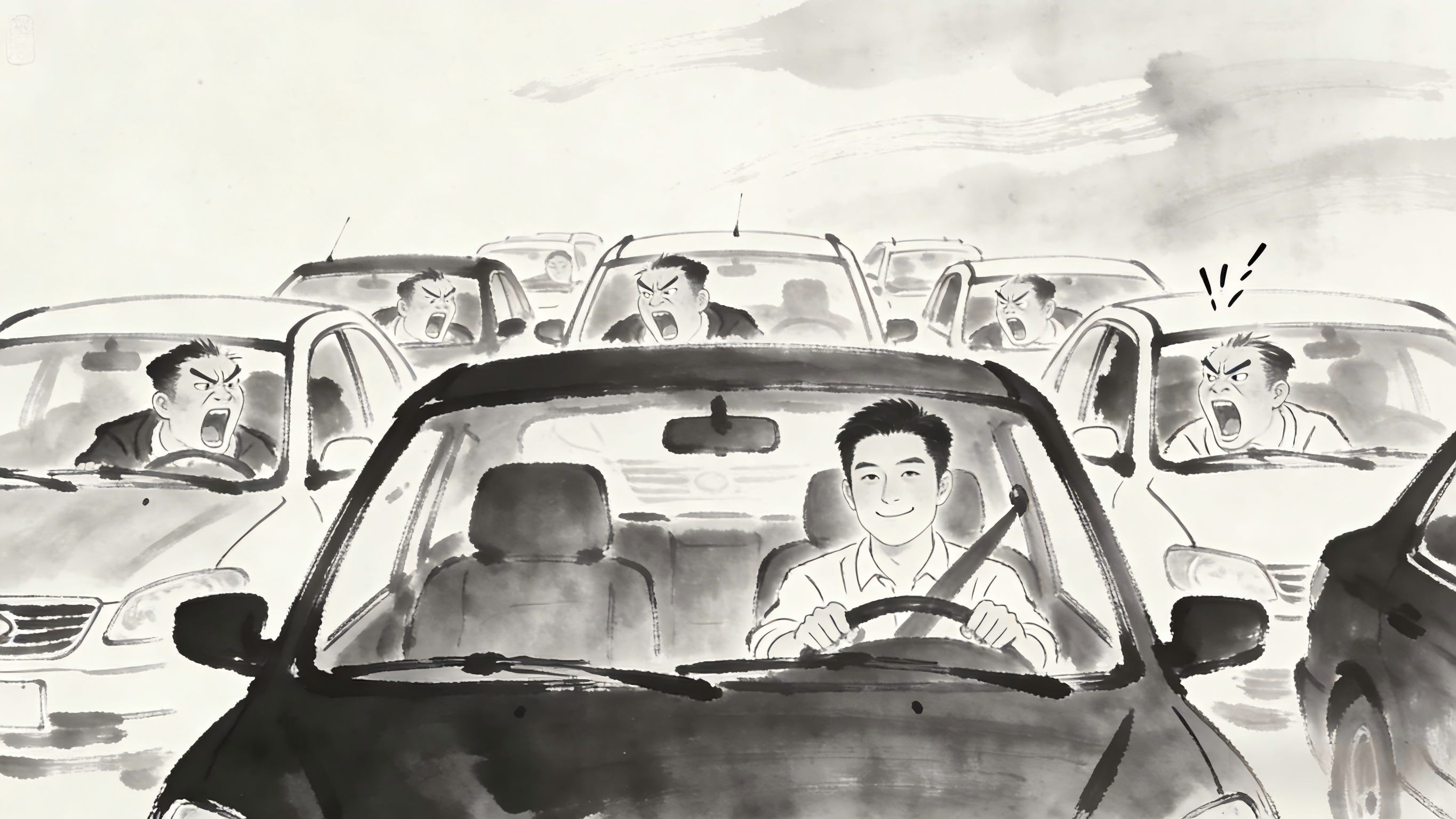
Second, the highway: You’re stuck in rush-hour traffic, already running late for a meeting. Suddenly, a car swerves into your lane without signaling, then slams on the brakes. Behind you, someone blasts their horn, long, loud, and angry. Instantly, your chest tightens. Your jaw clenches. Thoughts race:“How dare they?” “This is going to make me late.” “Why do people have to be so reckless?”
In that moment, you have a choice. You can let the anger take over, yell, honk back, let the frustration ruin your entire morning. Or you can practice mindfulness. You can pause, notice the tightness in your chest, acknowledge the anger without feeding it, and remind yourself:“This is just a feeling. It will pass.”
You’re not trying to make the anger disappear. You’re not judging yourself for feeling it. You’re just observing it, watching how it rises in your body, how it tugs at your thoughts, how it eventually fades if you don’t cling to it.
This second scene isn’t a break from mindfulness. It’s mindfulness in its most powerful form.
The cushion teaches you the basics, but life’s annoyances teach you how to apply those basics when it matters most. They’re the difference between practicing a musical instrument in your bedroom and performing on stage.
You can drill the scales all you want, but until you’re faced with an audience, you won’t know if you can actually play with presence.
Why “Perfecting” the Cushion Isn’t Enough
Wang Yangming believed that wisdom is forged in action. He criticized scholars who studied ethics in books but failed to act with integrity in their daily lives, arguing that their “knowledge” was empty without practice.
The same goes for mindfulness.
You can read every book on present-moment awareness, meditate for hours a day, and quote spiritual teachers, but if you can’t stay present when life gets hard, you’re not truly practicing mindfulness.
You’re just going through the motions.
I used to fall into the trap of thinking: “Once I’m better at mindfulness on the cushion, I’ll be able to handle life’s stressors.” But that’s like saying: “Once I’m good at practicing yoga poses in a studio, I’ll be able to keep my balance while walking a tightrope*.”*
The skills are related, but one doesn’t automatically translate to the other. You have to practice balancing on the tightrope, just as you have to practice being mindful in traffic, in arguments, in the mundane, frustrating moments that make up most of life.
Your Daily Life Is Your Dojo
The good news is, every “annoyance” is an opportunity to practice.
The long line at the grocery store when you’re in a hurry? That’s your dojo. The coworker who takes credit for your work? That’s your scripture. The child who throws a tantrum in the middle of a restaurant? That’s your meditation.
These moments don’t just test your mindfulness, they deepen it. When you’re forced to stay present amid chaos, you learn that awareness isn’t dependent on calm surroundings. You learn that you can be aware of anger without being consumed by it, aware of frustration without acting on it, aware of stress without letting it define your day.
You also learn something deeper: that the peace you’re seeking on the cushion isn’t something you can only find in stillness. It’s something you can access even in the middle of a storm. It’s the space between you and your thoughts, between you and your emotions, a space that’s always there, waiting for you to notice it.
Wang Yangming once said,“The mind is the principle.” For mindfulness practitioners, this means that the awareness you cultivate on the cushion is the same awareness you need in daily life. It’s not a different skill, it’s the same skill, applied in different contexts.
And the more you apply it, the stronger it gets.
From Practice to Way of Life
I still meditate on the cushion. I still value those quiet moments of intentional practice. But I no longer see them as the “real” mindfulness. They’re the training ground, not the game.
The game is life, the messy, unpredictable, often frustrating life that doesn’t care about your meditation schedule or your spiritual goals.
Life will never slow down for your practice. It will never stop throwing curveballs, never stop testing your patience, never stop giving you opportunities to get pulled out of the present moment.
But that’s okay. Because those challenges aren’t obstacles. They’re gifts. They’re the moments that turn casual meditation into a way of life.
So the next time you’re meditating on the cushion, remember: you’re not just practicing for the sake of practicing. You’re training to be mindful when it matters most, when you’re angry, when you’re stressed, when you’re tempted to react instead of respond.
And the next time life throws you an annoyance, a honking horn, a long line, a difficult conversation, remember: this is your practice. This is where mindfulness becomes real. This is where you prove to yourself that you’re not just someone who meditates on a cushion. You’re someone who lives mindfully, in every moment, no matter what life brings.
Wang Yangming taught that true knowledge is action. For mindfulness, true practice is life. Stop waiting for the perfect conditions to be present. Stop saving your mindfulness for the cushion. Bring it to the grocery store, to the highway, to the arguments, to the mess.
That’s where the real spiritual growth happens. That’s where you learn to be present not just when it’s easy, but when it’s hard. That’s where mindfulness stops being a practice and becomes a way of being.
Life’s annoyances aren’t getting in the way of your mindfulness. They are your mindfulness. And once you realize that, you’ll never look at a traffic jam or a long line the same way again. You’ll see them for what they are: opportunities to grow, to deepen your awareness, and to live a more present, peaceful life—exactly as Wang Yangming intended.
So roll up your mat, turn off the meditation music, and step into life. Your practice is waiting for you.
P.S. What’s one “annoying” moment from your week that you could reframe as a mindfulness practice? Share your thoughts in the comments—I’d love to hear from you.