

I’ve noticed something about the human mind.
It seems to come equipped with a very sensitive judgment switch, one that turns on almost automatically.
You buy a piece of clothing, try it on at home, and the first thought is: this doesn’t look right. I shouldn’t have bought it.
You spend hours working on something, submit it, and immediately feel: it’s still not good enough. I could’ve done better.
You scroll through other people’s lives and catch yourself thinking: they’re not that impressive anyway.
And then, almost without pause, the harshest judgment lands on yourself.
Why am I like this?
Why can’t I do anything properly?
I’m just not good enough.
We’ve grown so used to measuring everything with the same ruler, good or bad, right or wrong, better or worse, that we rarely stop to question the ruler itself. We assume “not good enough” is an objective truth, rather than a habit of perception.
But what if the problem isn’t you?
What if the idea of “not good enough” is fundamentally flawed?
Today, I don’t want to offer a grand philosophy or a technique to improve yourself. I want to invite you to look at things from a slightly wider angle.
What if everything, every person, every situation, every version of you, is simply at its current stage of evolution?
Seen this way, every moment is already complete at the level it exists.
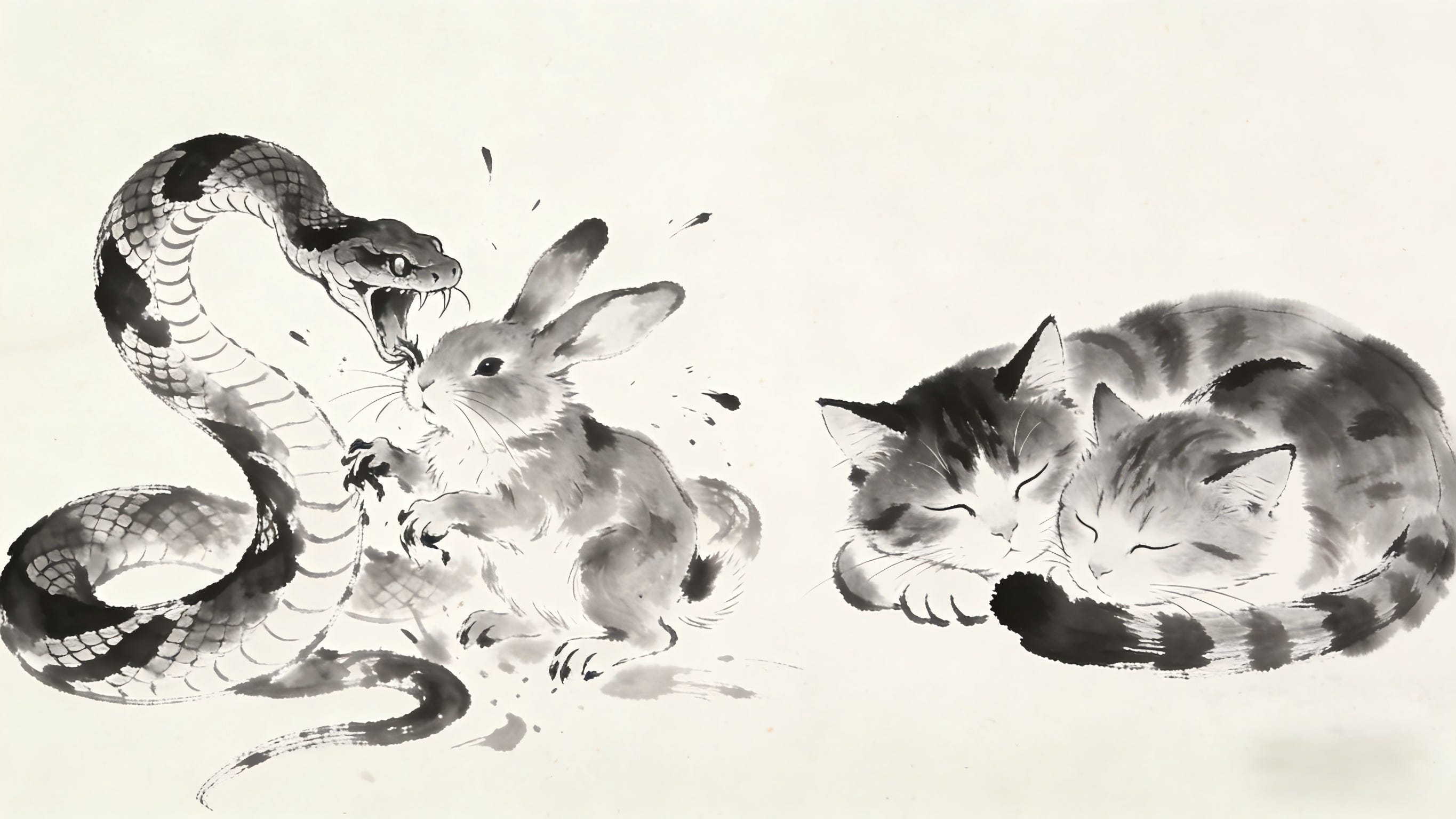
Think about a snake hunting its prey. Compared to a gentle, affectionate animal like a cat, the snake can seem cold, even cruel. Our judgment arises instantly. That’s harsh. That’s wrong.
But from the snake’s perspective, this is not cruelty. It is life expressing itself exactly as it must. It is adaptation. It is survival. It is the most precise and honest expression of what a snake is.
There is no moral failure in it. No “not good enough.” Just life doing what life does.
Or consider a rose.
Is a half-open rose inferior to one in full bloom?
Most of us instinctively say the fully bloomed rose is better. More impressive. More complete.
But is it?
If time were to pause in that moment, the half-open rose would still be perfect as it is. It carries a quiet tenderness, a sense of anticipation, a different kind of beauty than the flower in full bloom. One is not better than the other. They are simply different expressions of the same life at different stages.
The tragedy is that we rarely grant ourselves the same generosity.
When we look at our own lives, we forget that we too are always in motion. Always unfolding. Always learning. We judge a single moment as if it were the final verdict on who we are.
We say, I’m not good enough, without acknowledging the context. The limitations. The effort already given. The conditions we’re working within.
We overlook a crucial truth. At any given moment, you are already doing the best you can with the awareness, energy, and resources available to you.
This doesn’t mean there’s no room for growth. It means growth does not require self-contempt.
Our judgments are rarely complete. They are fragments taken out of a much larger picture. We see the snake’s strike but not the ecosystem it belongs to. We see the rose’s unopened petals but forget that blooming is a process, not a demand.
And when we judge ourselves harshly, we do the same thing. We isolate one moment, one mistake, one shortcoming, and use it to define the whole.
But life is not a multiple-choice exam with a single correct answer. It is plural. Diverse. Unfinished by nature.
Evolution does not leap. It unfolds.
The parts of yourself you label as “not good enough” may simply be aspects that haven’t reached their next expression yet. They may be gathering strength. Learning quietly. Preparing for something you cannot yet see.
The same is true of the people and situations you struggle to accept. They, too, are moving through their own stages, at their own pace, shaped by conditions you may never fully know.
When you begin to see life this way, something softens.
You stop demanding that everything, and everyone, arrive fully formed. You stop treating the present moment as a failure just because it isn’t the final version.
Acceptance doesn’t mean resignation. It means honesty. It means recognizing what is here without adding unnecessary cruelty on top of it.
When you stop forcing reality into categories of good and bad, success and failure, something surprising happens. You begin to see beauty where you once saw only flaws. You begin to meet yourself with patience instead of pressure.
And perhaps most importantly, you begin to make peace with being unfinished.
So the next time that familiar voice says, this isn’t good enough, pause for a moment.
Ask yourself: good enough for what? Compared to which imaginary standard? At what stage of a process I’m pretending should already be complete?
What you call imperfection may simply be life, exactly where it is supposed to be.
When you stop condemning the present moment for not being something else, you begin to see it clearly. And in that clarity, a quieter kind of kindness emerges. Toward yourself. Toward others. Toward life as it unfolds.
Not perfect in the way the mind demands.
But perfect in the only way that actually exists.