

There was a period in my life when I really wanted to run away from ordinary life.
I wanted to leave daily life behind and go to a monastery. In my mind, a monastery was a place where all I had to do was meditate, practice, and focus on transcendence. No chaos, no mundane responsibilities, no emotional friction, no endless little things pulling at me. Just silence, depth, and spiritual work.
At that time, I really believed transcendence lived somewhere outside ordinary life. I thought daily life was the obstacle.
The noise, the repetition, the emotional pain, the unpredictability — all of it felt like the opposite of the spiritual path. I wanted to get beyond it. I wanted unity, peace, love, non-separation. And I thought the monastery was the place where those things could finally be found.
Looking back, I can see something more clearly now. What I was really seeking was not just transcendence. I was also seeking relief. I wanted out of the discomfort of being human in ordinary life. I was resisting the pain, the boredom, the messiness, and the constant friction of daily experience. And at the same time, I was attached to some ideal spiritual state I had read about in books.
That created a split in me. On one side was the ideal: enlightenment, unity, love, freedom from suffering. On the other side was my actual life: washing dishes, folding clothes, feeling resentment, having a wandering mind, getting triggered, feeling disconnected, dealing with responsibilities.
And because I kept comparing daily life to that ideal state, daily life started to feel even more dull, more painful, more lacking.
But gradually, I began to see something I couldn’t see before: the desire to escape ordinary life was itself part of the obstacle.
Daily life is not the obstacle
I can’t tell you exactly when this shifted. It didn’t happen all at once. It happened gradually.
A few teachers really helped point the way for me. David Hawkins helped me see that daily life brings up emotions, and those emotions are not interruptions to the path. They are the path. They are opportunities to let go.
Michael Singer pointed to something similar. When daily life triggers frustration, anger, fear, craving, or emotional contraction, the practice is not to run away from those experiences. The practice is to be with them, to relax around them, to stop trying to force or control them, and to let the energy move through.
Other mindfulness teachers helped me see even more clearly that spiritual practice does not need to be separated from ordinary life. You do not need to leave the world in order to wake up. In fact, daily life itself can become the training ground.
That realization changed a lot for me.
Because once you really see this, the whole thing flips. The ordinary is not what blocks transcendence. The ordinary is where the path actually happens.
The world is not the real problem
Something else became more obvious to me over time.
When I listen to stories from deeply awakened people, what stands out is not that they escaped the world. It’s that the world changed in how it appeared to them.
The ordinary became luminous. A street, a tree moving in the wind, the sound of the city, even pain, even difficulty — all of it could be experienced differently.
So it started to seem to me that the problem was never the world itself. The problem was the state we were in while perceiving it.
And I’ve tasted this a little myself. Not fully, not steadily, and definitely not all the time. But enough to trust that something real is there.
Sometimes I’m just walking down an ordinary street in an ordinary city, and suddenly there is a sense of silence underneath everything. Or gratitude. Or some kind of harmony behind the noise.
Sometimes the leaves moving in the wind feel beautiful in a way that doesn’t need explanation.
Sometimes I still get criticized, but I recover faster. I forgive faster. I don’t get trapped in the same way.
These are small things, but to me they matter. They show me that the ordinary is not as ordinary as I once thought.
Why daily life is actually so useful
I think there are at least two gifts in practicing in ordinary life.
The first is that daily life shows you where you really are.
It’s easy to feel spiritual when nothing is bothering you. But what happens when someone criticizes you? What happens when your child is crying, when your boss pressures you, when you feel rejected, anxious, bored, resentful, or ashamed?
That is where you start to see your real level.
Daily life gives you feedback. If someone speaks harshly to you and you burn with anger for three days, that shows you something. If, after some sincere practice, the same thing happens and the anger still comes but passes in a few hours, that also shows you something.
The second gift is that daily life reveals your blockages.
The world triggers what is already inside us. If someone criticizes me and I feel intense anger, yes, the criticism triggered it. But the deeper issue is that there was already anger in me waiting to be triggered.
If I fail at something and immediately feel worthless, that event did not create worthlessness out of nowhere. It revealed a wound, a belief, or a pattern that was already there.
So daily life keeps showing us what still needs awareness, love, release, and integration.
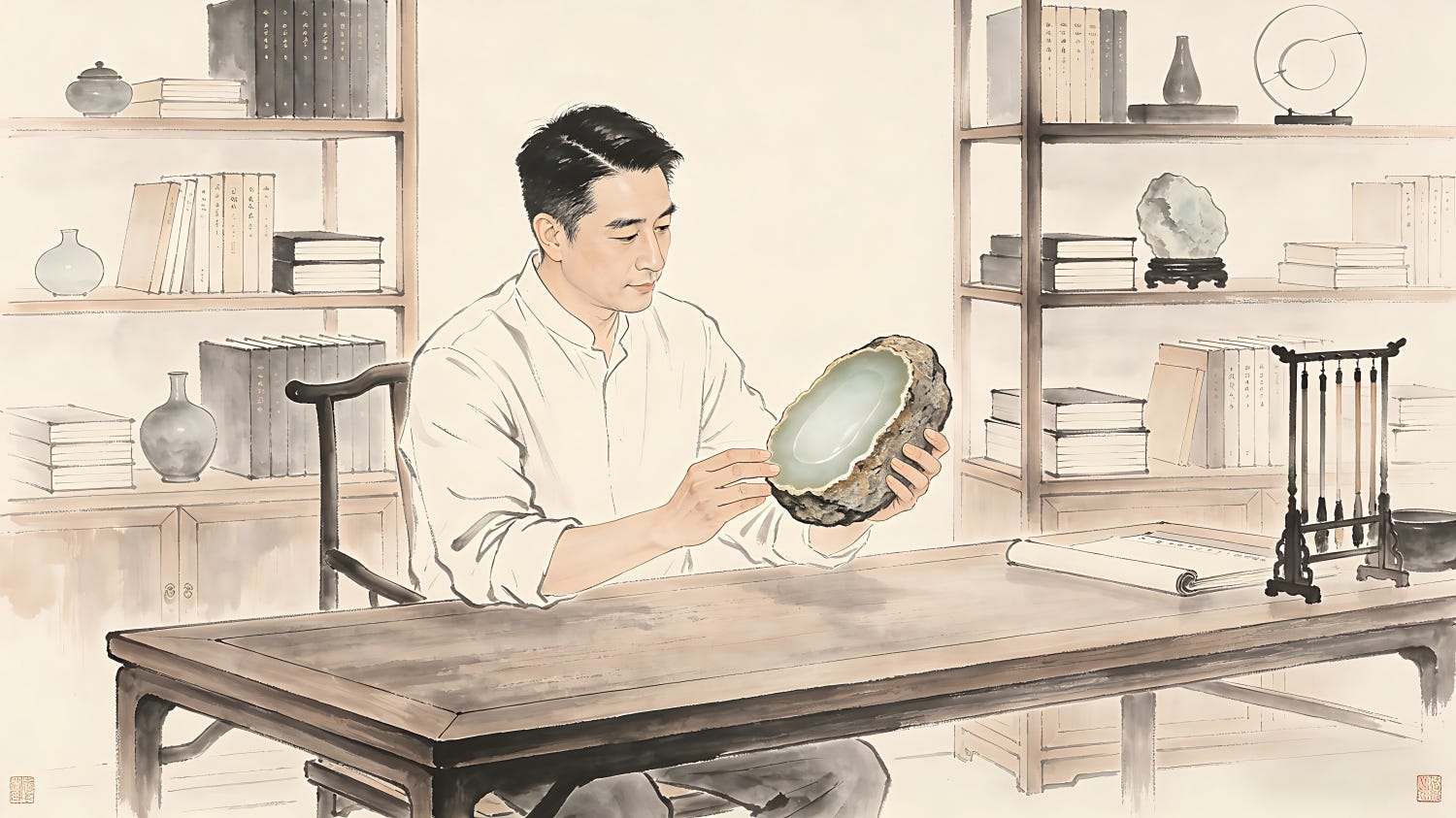
That is why I no longer think the painful and ordinary parts of life are random inconveniences. For the practitioner, they are raw jade.
Raw jade
A piece of raw jade doesn’t look impressive at first. It can look like just another rough stone. If you didn’t know what it was, you might overlook it completely or even throw it away.
But inside, there is something precious. It just hasn’t been revealed yet.
That image has stayed with me because I think our ordinary moments are often like that. A headache, a wandering mind, a day of disconnection, resentment, restlessness, shame, loneliness, boredom — these are the rough stones of life. Most of the time we reject them. We want them gone. We assume they are getting in the way.
But what if they are not in the way? What if they are actually where the work is?
Then the question becomes: how do we polish the stone without rejecting it?
Love the ordinary
More and more, I feel the answer is love.
Not sentimental love. Not pretending everything feels good. I mean a very simple and courageous kind of love: not rejecting what is here.
The ordinary needs to be loved. The painful needs to be loved. The parts of ourselves we want to push away — shame, anger, restlessness, jealousy, grief, numbness — also need to be met with love.
Because when we resist, it persists. Resistance itself is often part of the blockage.
But when we stop rejecting what is here, something begins to soften. Something can dissolve.
I often think of it like how a loving parent looks at a child. To a stranger, the child may seem ordinary, difficult, noisy, even annoying. But to a loving parent, that child is deeply worthy of love exactly as they are.
That doesn’t mean the child is perfect by worldly standards. It means they are fully worthy of love.
I think this is the attitude we need toward our own ordinary and painful experience. Even this headache. Even this wandering mind. Even this loneliness. Even this resentment.
Not because these experiences are pleasant, but because they are part of what is here now. And what is here now is where the path is.
A simple way to practice this
So what does this actually look like in practice?
Not as an idea, but as something you can really do?
The way I understand it now is actually pretty simple. It’s not complicated. It’s more about attitude than technique.
Step 1: Settle in and check what is here
First, just settle.
Sit down. Relax your shoulders, your jaw, your face. Let the spine be upright but not rigid. The point is not to force yourself into some spiritual posture. The point is to become alert and relaxed at the same time.
Then just check in with your inner state.
What is happening in the body right now? Is there tightness, pressure, heaviness, warmth, agitation, tiredness?
What is happening emotionally? Is there anxiety, sadness, irritation, loneliness, dullness?
What is happening mentally? What thoughts are running? What kind of inner talk is there? What kind of mental movies are playing?
You can also notice what is happening outside you. Sounds in the room. What you see if your eyes are open. Maybe something pleasant, maybe something unpleasant, maybe something neutral.
Just notice the whole field of experience.
Step 2: Notice what you are calling “not perfect”
Then see if there is something in your present experience that you are silently rejecting.
Usually there is.
Maybe it’s a headache. Maybe it’s restlessness. Maybe your mind keeps wandering. Maybe you feel disconnected, ashamed, bored, numb, or irritated.
These are usually the parts we label as bad, flawed, inconvenient, or in the way. We think, this shouldn’t be here. We think, I need to get rid of this before I can really practice.
But this is exactly where the shift begins.
Instead of calling that experience a mistake, you begin to recognize it as part of the path.
Step 3: Affirm its perfection
This step may sound strange at first, but I think it matters.
Take the thing you are resisting and quietly say to it: This is perfect.
Not because it feels pleasant. Not because you are pretending to like it. Not because you are doing positive thinking.
You are saying it in a deeper sense.
You are saying: this too belongs. This too has a place. This too is part of reality right now. I do not need to reject it.
If there is a headache, you can bring your attention to it and say, this is perfect.
If there is a wandering mind, this is perfect.
If there is loneliness, this is perfect.
If there is restlessness, this is perfect.
To me, this does not mean we glorify suffering. It means we stop acting as if this moment has gone wrong just because it contains discomfort.
The raw jade may not look beautiful yet, but that doesn’t mean the jade is not there.
Step 4: Meet it with love
Then from there, bring kindness.
Not analysis. Not fixing. Not argument. Just kindness.
Almost like you are sitting with a child who is crying. You do not need to lecture the child. You do not need to tell them to stop. You do not need to explain why they shouldn’t feel what they feel.
You just stay with them.
That is love.
And in the same way, you stay with your own discomfort. You let it be seen. You let it be felt. You let it be held in a wider field of acceptance.
Sometimes it helps to inwardly say something like: I accept you. It’s okay for you to be here.
This is where the practice becomes more than mental. It becomes a heart practice.
And sometimes, if you really stay there, you can actually feel something soften in the chest. A warmth. A tenderness. A real compassion toward your own humanity.
That matters.
Because a lot of what keeps suffering in place is not just the pain itself. It is the rejection of it. The shame around it. The feeling that this part of us should not exist.
Love begins to loosen that knot.
And if it feels real, let it widen
If the practice starts to feel real in you — if there is genuine kindness there — then sometimes I like to let it widen.
I think about all the other people feeling this same kind of thing. Other people feeling boredom, loneliness, shame, resentment, confusion, disappointment. Other people sitting with headaches, wandering minds, tired hearts.
And I just let the love widen a little.
Nothing dramatic. Just a quiet recognition that this is part of being human, and that none of us are alone in it.
This moment is the practice
So scrubbing a pot, folding clothes, walking down the street, drinking a glass of water, hearing a baby cry, feeling irritation rise — these are not distractions from practice.
They are practice.
The moment you stop dividing life into “spiritual things” and “non-spiritual things,” something starts to change. You stop waiting for a more sacred moment. You stop imagining that real practice begins somewhere else, under better conditions, in a quieter place, after life becomes easier.
You begin to see that this moment is already it.
And I think this is one of the deepest shifts: not trying to escape life, but learning to awaken to it.
Not later. Not elsewhere. Not after everything is fixed.
Here, in the middle of ordinary life.
That is where the jade is.
The right motivation impuls to implement mindfullness in daily life. I will now try this meditation. ☺️
Thanks for sharing, it’s just what I needed to read today ✨🌊