

Hey, it’s Muse again.
For this one, I want to share three simple ideas about meditation that I think can help make it feel less mysterious.
A lot of people think meditation means emptying the mind. A lot of people also don’t really know how to observe their thoughts. And many people still feel like mindfulness is some special spiritual thing only certain people can do.
I don’t think that’s true.
So here are three reflections.
1. Meditation is not zoning out
A lot of people think meditation means “emptying yourself out.”
They think meditation is basically blanking the mind, spacing out, or becoming empty.
But I think that’s actually the opposite of meditation.
Because when people “zone out,” they are often still thinking a lot. They just don’t know they are thinking. Their awareness is low. So if you interrupt them and ask, “What were you thinking about?” they may say, “Nothing,” but that usually isn’t true. They were thinking, but they were not aware of it.
Meditation, to me, is not that.
I would define meditation much more simply as non-judging awareness of present-moment experience.
That experience may be bodily sensation. It may be thoughts. It may be sounds. It may be emotions. But the key thing is that you are aware.
So if you are lost in thought and then later don’t even know what you were thinking about, that is not meditation. That is more like unconscious drifting.
A very simple example is washing dishes.
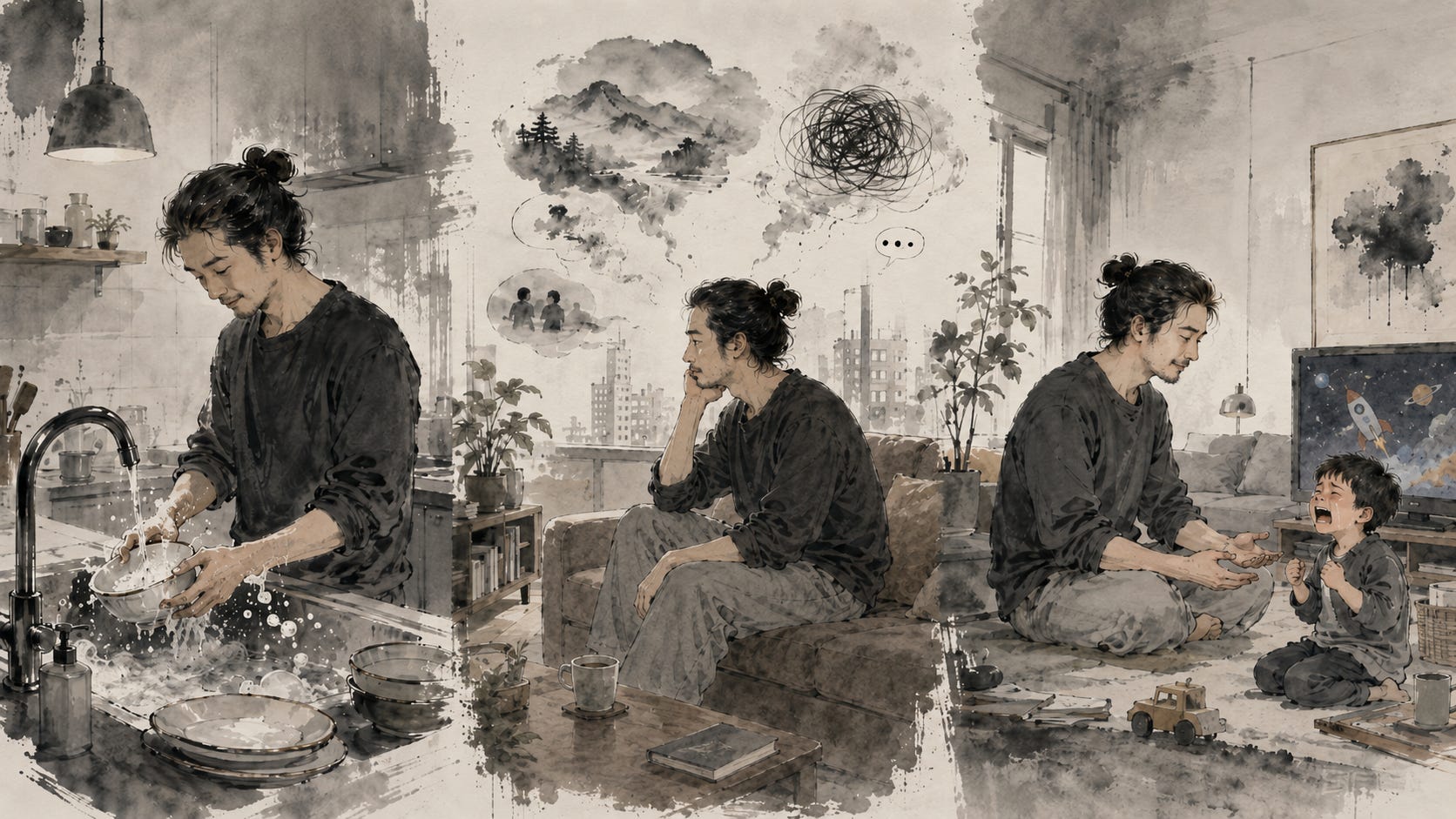
You can wash dishes in a zoned-out way. Your hands are moving, but your mind is somewhere else. You are thinking about yesterday, tomorrow, what someone said about you, what you should do next, and so on. The dishes still get washed because washing dishes is easy. Maybe they just don’t get washed very well.
But you can also wash dishes in a meditative way.
In that case, your attention is actually on washing dishes. You notice the flow of the water. You notice the bubbles. You notice the feeling of water touching your hands, and your hands touching the bowl. You notice the grease slowly disappearing. You notice the small satisfaction of putting the last bowl down and realizing, oh, I finished.
That small satisfaction becomes much bigger when your attention is really there.
So to me, meditation is not about making experience disappear. It is about actually being there for it.
And when you are there for even simple things, life becomes less dull. Even washing dishes can become part of practice, and even a small task can contain a small happiness.
2. Learning to observe your thoughts can save you from getting pulled around by them
The second thing I want to talk about is thoughts.
A lot of people think thoughts are just words in the mind. But actually, I think thoughts usually have at least two forms.
One is inner talk. That is the voice in your mind, the sentences, the comments, the inner monologue.
The other is inner imagery. That is what you inwardly see. Sometimes it’s a clear image, sometimes a vague picture, sometimes almost like a little movie playing inside.
So when I talk about observing thoughts, I’m not only talking about words. I’m also talking about the images that arise in the mind.
Why does this matter?
Because if you can observe your thoughts, you stop being completely trapped inside them.
For example, maybe a thought appears: “I’m no good. I can’t do anything well.”
If you have no mindfulness at all, you may immediately believe the thought. Then you start building a whole case for it. You remember all your failures. You remember what someone said. You get more and more convinced. Soon the thought becomes your reality.
But if the thought appears and you can notice, “Oh, that is inner talk. That is a thought,” then you already have some distance from it.
You and the thought are no longer exactly the same thing.
That is very important, because a lot of our thoughts are not solid truth. They are interpretations, habits, reactions, moods, stories. The same goes for the way we judge other people and ourselves. Most of that is much less certain than it feels in the moment.
This can help a lot in family life too.
For example, if your child is crying or acting badly, maybe you suddenly see an inner image of yourself yelling at them. Or you hear inner talk saying something harsh. If you can catch that before acting on it, you have a chance not to follow it.
That can save you from doing things you’ll regret later.
So how do I practice observing thoughts?
One way is indirect. If you do simple breath meditation, you keep bringing your attention back to the breath. While doing that, you begin to notice that thoughts arise by themselves. You don’t know in advance what the next thought will be. It just comes. Then it changes. Then it disappears. Seeing that is already a kind of observing thoughts.
Another way is more direct.
You can notice outer sounds and label them, like “hear out.” Then when you suddenly catch the inner voice commenting on that sound, you label it as “hear in.” And if an inner image appears, you notice that too.
Over time, this gives you the feeling that thoughts are things appearing in awareness, not the essence of who you are.
That is a very useful shift.
3. Mindfulness is not something mysterious. It is a skill you can train.
The last thing I want to say is this: please don’t treat mindfulness meditation like something mystical or only for special people.
I really think it is better to think of it as a skill.
Like learning an instrument.
If you practice guitar every day for years, you will get better. Maybe some skills are harder than others, but the basic principle is not mysterious. You train, and slowly the skill grows.
Mindfulness is like that too.
If I had to describe it simply, I would say it is the skill of being with present experience unconditionally.
What does that mean?
Let’s say you feel nervous before an exam, or before meeting someone important. What does it mean not to be with the experience? Usually it means you immediately try to escape. Maybe you grab your phone and start scrolling. Or you start spinning in thought. Or you go talk to someone just to get away from the feeling.
That is not being with the experience.
Being with the experience means noticing: where is this nervousness in the body? Is it tightness in the chest? A strange feeling in the stomach? Something in the throat?
Then you stay with it.
You don’t run.
You don’t suppress.
You don’t immediately try to fix it.
You just stay with it.
At first, maybe you can only do that for a few seconds. Then you want to escape again. That’s normal. But with practice, maybe you can stay a little longer. Then longer. Then one day you can sit with it for half an hour or an hour, and something starts to change.
This is why I call it a skill.
And like any skill, life is where you test it.
I had a very clear example of this recently. I was under stress. My wife had been sick, work was stressful, and there were a lot of emotions in me. I happened to sit quietly with those feelings for half an hour. Then later my six-year-old came home, wanted to watch TV too late, and started crying and making a scene.
Normally, that would stir up a lot in me too. Maybe irritation, maybe sadness, maybe anger.
But that day there was almost no ripple inside.
So I didn’t explode, and I didn’t need to lecture him much either. I just let him have his emotions, and eventually he settled down.
That moment showed me something.
When you’ve really practiced being with your own inner storm, sometimes the outer storm can no longer hook you in the same way.
That’s when you know the skill is becoming real.
So to me, mindfulness is not something mysterious. It is a trainable skill. Anyone can practice it. And the proof is not some spiritual title. The proof is in life itself.
Maybe a month ago you would have exploded, and now you don’t. Maybe before you stayed angry for hours, and now it passes faster. Maybe before you had to dump the emotion on someone else, and now you can dissolve it inside.
That is real practice.
That is real progress.