

Hey, it’s Muse again.
For this one, I want to share three ideas about meditation that I think matter a lot, especially for ordinary people living ordinary lives.
Not people living in monasteries. Not people trying to disappear into some perfect spiritual state. I mean people with jobs, family, stress, responsibilities, and not that much free time.
So here are three reflections.
1. Meditation trains a bottom-layer life skill: attention
One reason I think meditation matters so much is that it trains something very basic, something underneath almost everything else in life.
That is attention.
No matter what you do in life, you are always using attention. You use it when you work, when you study, when you read, when you talk to people, when you raise children, when you deal with stress, even when you try to rest.
So if the quality of your attention improves, almost everything in your life can improve with it.
In Unified Mindfulness, one way to understand this is that attention is like a muscle. Just like you can go to the gym and train your physical muscles, you can also train the muscle of attention.
And to me, that muscle has three parts.
The first is concentration, or the ability to keep your attention where you want it to be. For example, maybe you are worried about something, but you are still able to keep bringing your attention back to your work or your study. That helps you finish what you need to finish, and often you handle the worry better afterward too.
But if you cannot hold your attention steady, then everything starts mixing together. You think about your worries while working, and then while trying to solve the worry, you think about work again.
Everything gets messy.
The second is clarity. This means you really experience what is happening now in a clear and rich way. Maybe you are outside in spring and there are flowers, trees, color, beauty, but if your attention is lost in your thoughts, you almost don’t experience any of it.
But if clarity is there, the beauty reaches you more fully. The same thing applies inwardly. If your boss criticizes you, and you can clearly notice the reactions rising in your mind, then you are less likely to get hijacked by them. You can respond better.
The third is equanimity, or what I sometimes think of as “flowing through.” Let’s say you have a headache. Someone with equanimity may still feel the headache, but they stop fighting it. The pain is there, but the mind is no longer making it ten times worse. Someone without equanimity starts thinking, why me, why today, now everything is ruined, and the suffering multiplies.
To me, these are like three muscles of attention. And meditation trains all three.
When these muscles get stronger, life gets richer. A flower becomes more beautiful. Criticism becomes less disturbing. Pain becomes less painful. The good becomes more vivid, and the difficult becomes more workable.
In that sense, meditation is not some side hobby. It is training a bottom-layer life skill.
2. Meditation has depth, but it also has breadth
When people think about meditation, they usually think about depth.
That part is easier to understand.
You sit down, close your eyes, follow the breath, and after some time the mind gets quieter. The world feels further away. The inside becomes still. That is depth.
You could say most people’s normal daily state is close to zero. The mind is wandering, emotions are moving everywhere, attention is scattered. Then during meditation, maybe you reach a six out of ten, or whatever your current limit is. That is depth.
But I think many people miss something important: meditation also has breadth.
What do I mean by breadth?
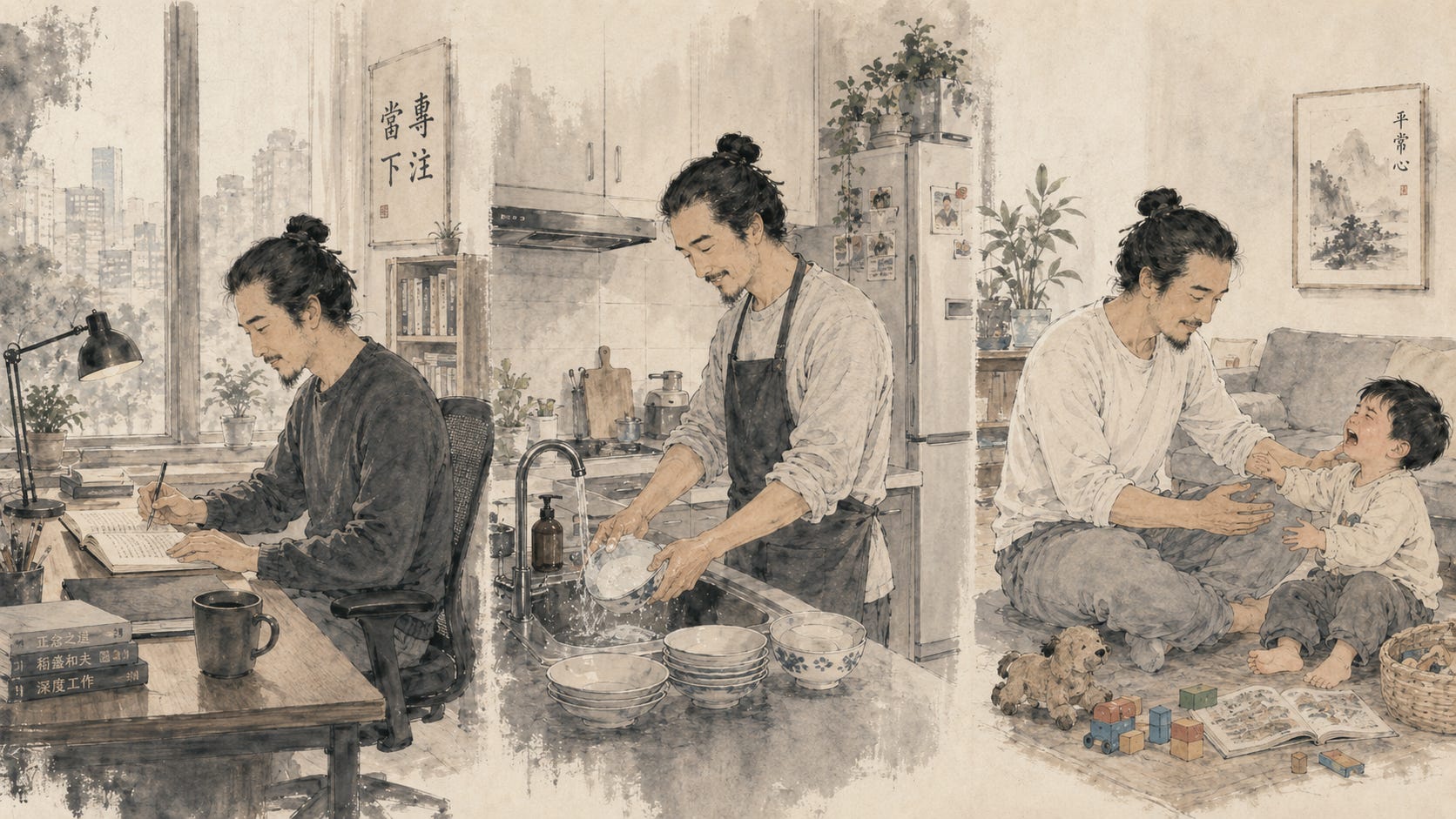
I mean: does meditation only exist when you are sitting alone with your eyes closed, or can some of that meditative state also be present while walking, washing dishes, chatting with someone, or doing your work?
That is breadth.
At first, maybe your seated practice has more depth than your daily life. That is normal. Maybe when you sit, you can reach a six, but when you walk mindfully, maybe you only reach a two. That is still good. Over time, both can grow.
This matters because ideally meditation does not stay trapped inside the formal session. It begins to spread into life.
Maybe you start with mindful walking, because walking is simple and does not require too much energy. Then maybe you bring some mindfulness into washing dishes. And if you really pay attention, even washing dishes is not boring. You can feel the water, the movement, the texture. It is more alive than we usually think.
So to me, meditation is not only about how deep you can go when sitting still. It is also about how widely that quality spreads through your day.
And if both depth and breadth keep growing, there may come a point where it feels less like “you are meditating” and more like “meditation is happening by itself.” You are being meditated, in a way.
When that begins to happen, life gets less heavy.
I think this is also why retreats can feel amazing, but then people come home and lose so much of it. They built depth, but not enough breadth. If you do not keep practicing in walking, working, talking, and daily life, then a lot of what you touched in retreat fades quickly.
So yes, depth matters. But breadth matters too.
3. For ordinary people, the most important meditation may be the one we do in life
A lot of people imagine meditation as sitting cross-legged alone in a quiet room, maybe with incense, maybe with no one around, entering some deep state.
That is part of meditation. But for ordinary people, I don’t think that is the whole picture.
A very useful definition of mindfulness meditation is simply this: non-judging awareness of present-moment experience.
If you are observing what is happening now, whether inside or outside, without resistance and without grasping, then in that moment you are in a meditative state.
And I think this matters a lot for ordinary people.
Because most ordinary people are not meditating mainly to get enlightened in some grand sense. Maybe that goal is there for some, and that is fine. But most people are practicing because they want less stress, fewer arguments, less suffering, and more peace in everyday life.
Maybe you want to stop snapping at your child so easily. If so, the key moment is not only when you are sitting on the cushion in the morning. The key moment is when anger rises in real life and you are able to notice it, feel it, and not immediately act it out.
That is where meditation starts becoming useful.
To me, seated meditation is a bit like learning basic basketball drills. You learn to dribble, pass, and shoot. That matters. But at some point you also have to play the game. You have to bring the skill into movement, into unpredictability, into real conditions.
Life is the game.
That is why moving meditation matters so much. If you do not have time to sit, you can still practice while brushing your teeth, walking down the hall, going from one hospital counter to another, washing dishes, or feeling your feet while moving.
The body is a great place to begin because bodily sensations are easier to notice. And once you get used to observing bodily sensation, you may find that you can also observe thoughts more clearly, and then emotions too, because emotions also show up in the body.
Then one day, in the middle of life, you may notice that you were about to get angry, but you didn’t. Or you were about to spiral into depressive thinking, but you didn’t. That is not a small thing. That is a real fruit of practice.
So for ordinary people, I think meditation in daily life is not secondary. It is essential.
And the beautiful thing is that the two support each other. The more you practice in life, the more you want to sit. The more you sit, the more you can practice in life.
That is how the snowball starts rolling.