

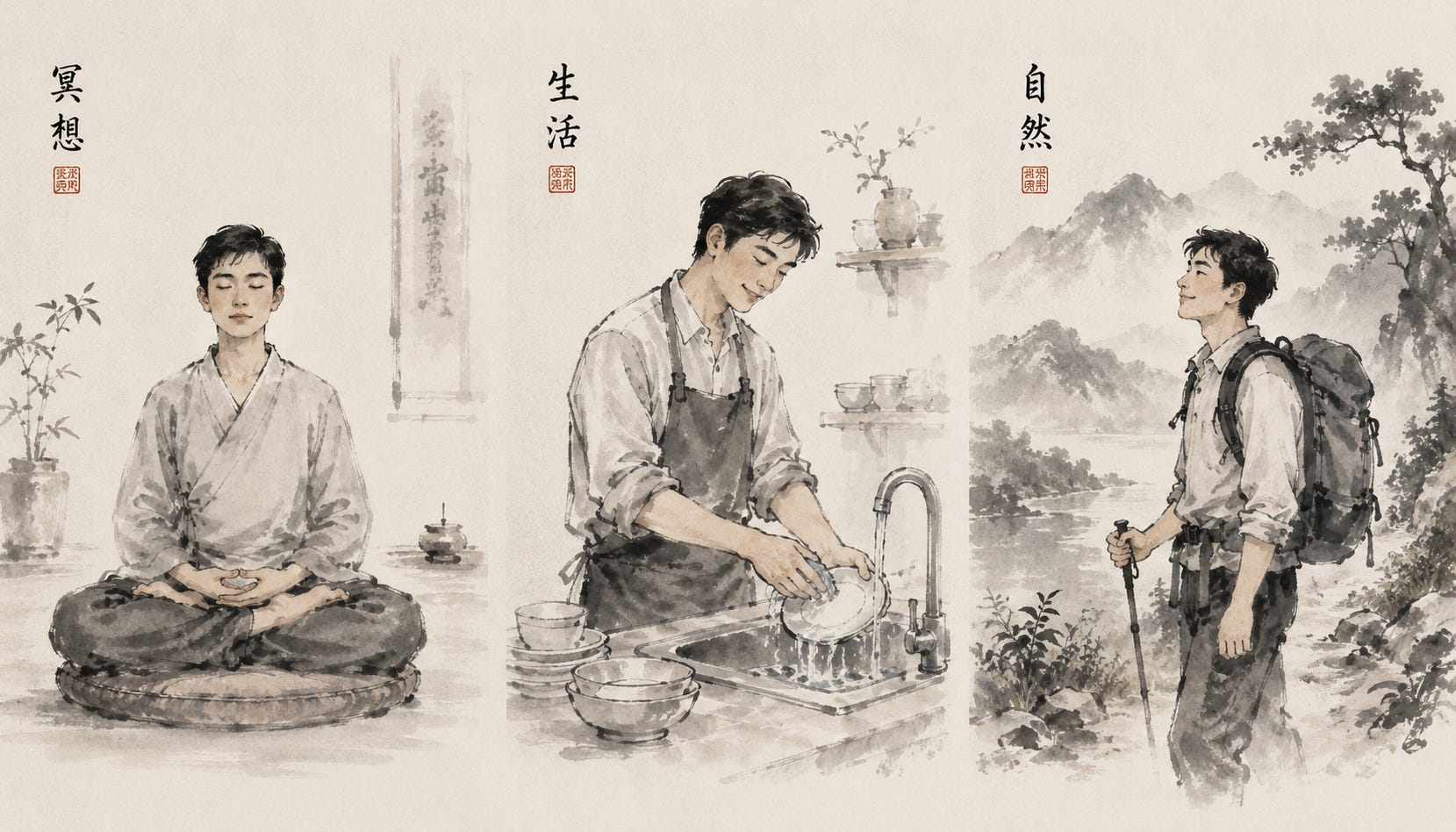
Hey, it’s Muse again.
For this one, I want to share three ideas I’ve been thinking about around meditation.
They all come from things I’ve experienced directly in practice, and also from questions I think a lot of people have.
Why keep meditating for so many years?
Why do some people meditate for a while and still feel emotionally stuck?
And what is meditation, really, beyond the mystery around the word?
So here are three reflections.
1. Why I keep meditating: because it points to a kind of happiness that doesn’t depend so much on life going my way
One big reason I’ve kept practicing meditation for over ten years is actually very simple.
There have been many times when I was just sitting there, doing nothing, and still felt a kind of inner peace, happiness, or quiet sense of fullness.
To me, that is kind of amazing.
Because for most people, happiness usually depends on something outside. You need to make more money, go on a trip, watch something entertaining, drink something, achieve something, buy something, or at least have life go your way for a while.
But when you sit down and do nothing, and still feel okay, or more than okay, sometimes even deeply content, that points to something very important.
It suggests that there is a kind of well-being that does not depend so heavily on conditions.
I think this is one of the deepest promises of meditation.
Not that you instantly become enlightened, and not that you never suffer again, but that you slowly move toward a kind of inner happiness that depends less and less on circumstance.
And I think that matters because life is unstable.
The people we love will not always stay.
The people who love us may one day leave too.
Money goes up and down.
Even the things we enjoy lose their charm.
A great show is not as exciting the second time.
A beautiful trip ends.
A good mood passes.
Life is full of impermanence.
So if your happiness depends completely on external things, then your happiness will always be shaky too.
But if you can sit quietly and still feel some peace, some enoughness, some okayness, then it feels like you have found something more stable. Something that can balance out the impermanence of life.
At least for now, this is one of the biggest reasons I keep practicing.
2. Why meditation can feel like it’s not working, especially when you still have strong emotions
A lot of people meditate for a while and then feel discouraged.
They think, I’ve been practicing, but I still have so many emotional problems. I still get angry, anxious, hurt, resentful, triggered. So is this even working?
I think one important reason is that our emotions are not just about what happened today.
A lot of what we feel is old.
You can think of it as accumulated emotional energy. When we were very young, we cried, got upset, and then often released it quickly. But as we got older, most of us learned to suppress emotion instead. We distract ourselves, explain it away, push it down, or try to forget it.
So what comes up now is often not just today’s frustration. It may also be years of built-up emotional energy getting activated by one event.
That means release takes time.
If you practice simple breath meditation, and you keep returning attention to the breath, some of that emotional energy may still be releasing in the background. But it is often gradual.
There is also a more direct way to work with emotion.
When something in life really triggers you, instead of exploding or distracting yourself, you can sit with the feeling.
Not with the story. With the feeling.
This is very important.
If you are angry, the mind will produce endless thoughts. Why did they do that? How dare they? What should I say back? All of that can go on forever. But the emotional energy itself is usually showing up in the body.
Maybe anger is tightness in the throat.
Maybe it is pressure in the chest.
Maybe it is heat in the stomach.
So the basic method is to find the bodily expression of the emotion, then stay with that feeling without resisting it, without grabbing at it, and without trying to force it away.
Just be with it.
To me, it’s a little like when a child is throwing a tantrum. If you don’t yell, don’t hit, and don’t try to argue them out of it, but just stay with them, eventually the energy passes. Then they come back.
Emotion can work like that too.
When you stay with the bodily feeling, sometimes it gets weaker. Sometimes it moves. Sometimes anger turns into sadness. That is okay. Change means something is releasing.
And if someone wants to work more actively, there is even a more intentional method. You can write down the things that still bother you, from small to big, and then during meditation bring one memory up, let the emotional reaction arise, and again stay with the bodily feeling instead of the thought stream.
Over time, some of those old charges really do lose their force.
Then the mind changes too. Not because you forced compassionate thoughts, but because once the emotional charge is less, the negative thinking naturally softens.
3. Meditation is less mysterious than people think: we already know its 3 basic states
A lot of people hear the word meditation and feel like it is something mysterious, or only for advanced spiritual people.
But I actually think meditation is much more ordinary than that.
You can think of it as entering certain mental states more intentionally.
And the truth is, most people have already tasted these states in daily life.
I like to think of meditation as developing three basic skills or states: concentration, clarity, and what I would call equanimity or release.
The first is concentration.
This is when your attention stays with one thing steadily. You may have felt this before while doing something you really care about. You get absorbed. You lose track of time. Your attention stays there naturally.
That is already a meditative state.
The second is clarity.
Maybe you’ve experienced this while hiking, being in nature, or sometimes even in a very vivid moment. Suddenly everything feels sharper. Colors look brighter. Sounds feel clearer. Time may even seem slower.
That is another meditative state.
The third is what I would call release, or equanimity.
This is when something unpleasant is still there, but you stop fighting it. Maybe you have a headache, and after resisting it for a while, suddenly you relax and accept it. The pain may still be there, but the suffering drops. Or after a breakup, one day you just let go. The pain is no longer gripping you in the same way.
That is also a meditative state.
So to me, meditation is not some exotic thing. It is the cultivation of capacities we already have.
You could say the three basic skills are: staying focused, seeing clearly, and allowing experience to pass through without getting so stuck.
For most people, these states happen only by chance.
But with meditation, you can train them.
And that is why I think meditation should feel much less mysterious than many people imagine. Everyone has attention. Everyone already knows these states a little. So in that sense, everyone can practice.