

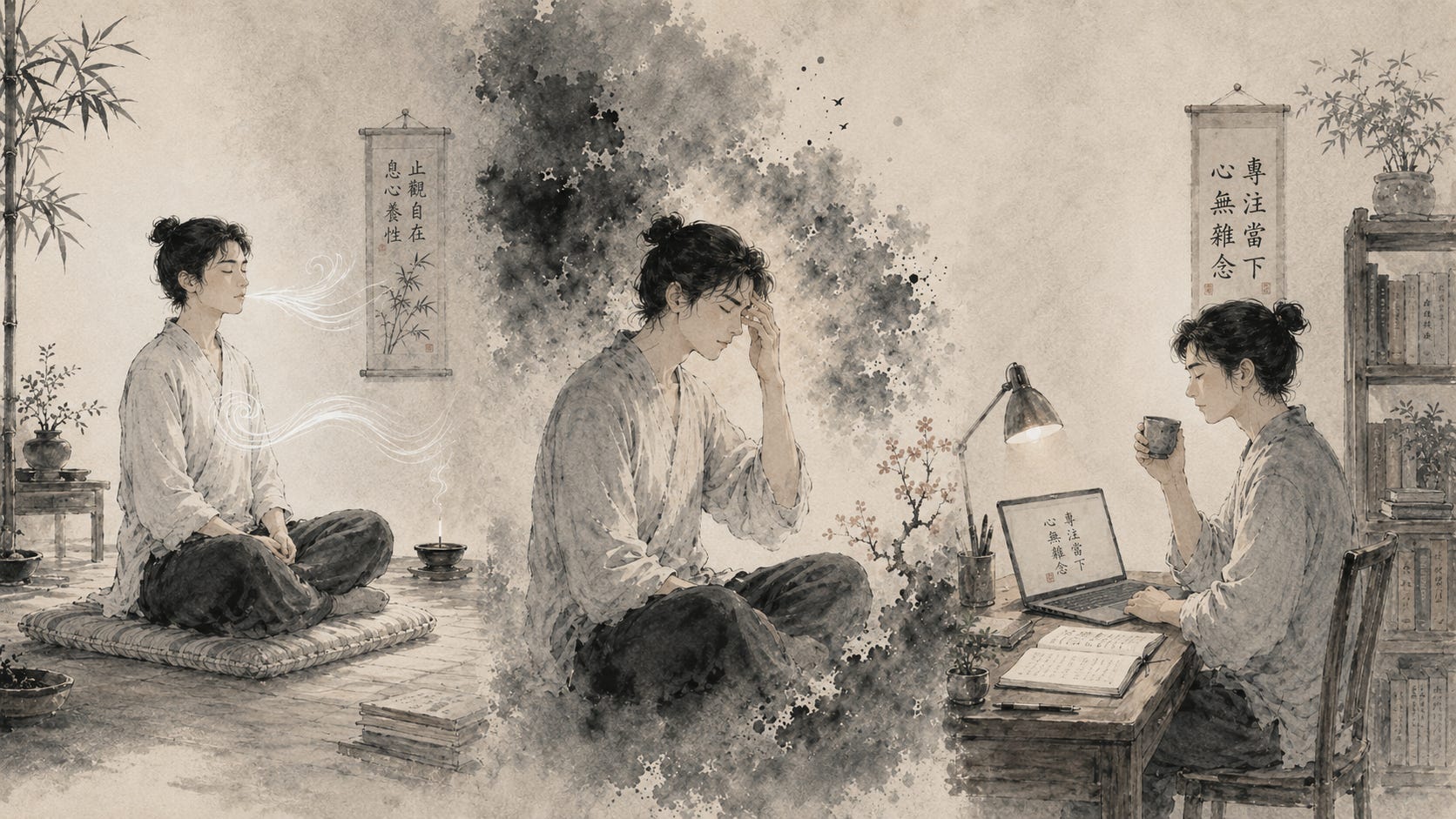
Hey, it’s Muse again. Glad to see you here.
I’m on a mission to share how we can bring mindfulness into daily life, even continuously throughout the day, to relieve pain and cultivate fulfillment.
For each newsletter, I’ve decided to share three ideas I’m learning, practicing, or deepening.
So here it goes.
A lot of people think mindfulness meditation has to be something special.
You sit on a cushion. You close your eyes. You become very calm. You enter some beautiful spiritual state.
But in real life, mindfulness can be much simpler than that.
It can be breathing.
It can be feeling a headache.
It can be noticing your body while walking to get a glass of water.
The core of mindfulness is not complicated. It is a non-judging awareness of the present moment. You can be aware of your breath, your body, your thoughts, your inner images, your emotions, or even the world around you.
The practice is not about forcing yourself to become peaceful.
It is about coming back to what is already happening, again and again.
1. Breathing Meditation: The Easiest Door for Beginners
For mindfulness meditation, technically you can use almost any experience as your object.
You can observe your thoughts. You can observe sounds. You can observe the outside world. But for many people, breathing is one of the best places to start.
Why?
Because breath is simple. It is neutral. It is always happening as long as you are alive.
Observing thoughts can be difficult for beginners because thoughts easily pull you in. One thought becomes another thought. Suddenly you are planning tomorrow, remembering yesterday, or arguing with someone in your head.
But breath is just breath.
One common way is to observe the breath at the nose. You pay attention to the air coming in and going out. You notice the subtle feeling of air touching the inside of the nostrils, or the area around the upper lip.
You may notice that the in-breath feels stronger, cooler, or more obvious. The out-breath may feel weaker. Sometimes you may not feel much during the out-breath. That is okay too. You can simply notice, “There is not much sensation right now.”
Another way is to observe the rise and fall of the belly.
When you breathe in, the belly rises. There may be a slight feeling of expansion or tension. When you breathe out, the belly falls. There may be a feeling of release or relaxation.
There is a kind of yin and yang inside this. In-breath and out-breath. Expansion and release. Tension and relaxation. If you stay with it patiently, it can become surprisingly interesting.
Of course, your mind will wander.
This is not a mistake. This is not failure. This is completely normal.
When your attention goes to thoughts, sounds, memories, or plans, just gently bring it back to the breath. Every time you bring it back, you are training concentration.
And if you do not judge yourself when you get distracted, you are training another important skill: equanimity.
Equanimity means you do not fight with the experience. You do not add, “I am bad at meditation. I can’t do this. My mind is too messy.” You simply notice what happened and return.
For people who get distracted very easily, counting can help.
You can breathe in and out, then count one. Breathe in and out, count two. Continue until ten, then start again from one.
If you want to make it even easier to focus, you can close your eyes and imagine the number in front of you. When you count one, see the number one. When you count two, see the number two. You can even make the numbers colorful, cartoon-like, or interesting.
At the same time, you can listen to the inner voice saying the number. So part of your attention is on the body, part is on the inner sound, and part is on the inner image.
In a way, you are filling the inner system with the meditation object: seeing, hearing, and feeling.
This can help because many distractions also come through inner seeing and inner hearing. You remember something as an image. You hear yourself thinking about tomorrow. With counting, you give the mind something simple and steady to hold.
And when distraction still happens, again, it is about equanimity.
You come back.
That coming back is the practice.
2. Using Mindfulness to Soften Stress Headaches
Sometimes we have headaches because of illness.
But many times, especially with stress-type headaches, the pain seems to come from nowhere. There is no obvious reason, but the head hurts.
I used to have many of these headaches. For me, mindfulness often reduced the pain by around 50%, sometimes more.
The first step is acceptance.
This does not mean you like the headache. It does not mean you refuse medicine or medical help when needed. It simply means you stop adding the second layer of suffering.
The first layer is the physical pain.
The second layer is resistance: “Why is this happening? I hate this. What if it gets worse? I can’t handle this.”
That second layer creates more suffering on top of the pain.
So the first move is to allow the pain to be here, at least for this moment.
Then, if you can, sit down quietly. You do not have to sit in any special posture. Close your eyes if that feels comfortable.
Now comes the counterintuitive part: put your attention on the headache.
Most of us want to escape pain. We want to move away from it, ignore it, or push it away. But if the headache is related to accumulated stress, turning toward it with awareness can help the body and mind release some of that pressure.
You can observe the headache in detail.
Where exactly is it?
Is it more on the left or the right?
How big is the area?
Where are the edges?
Does it reach the eyes? The temples? The forehead? The back of the head?
Is it steady, pulsing, vibrating, moving, expanding, shrinking?
These details matter because the more clearly you observe the headache, the more you stay with it in the present moment. And the more you stay with it, the less you resist it.
When resistance softens, the stress behind the pain can begin to release.
You can also keep part of your attention on the dark or gray visual field behind closed eyes. This can be relaxing. It gives the mind something soft to rest on while another part of your attention feels the headache directly.
You may also observe the breath at the same time. Breath is changing. Pain is also changing. When you notice that the pain is not a solid thing, but something shifting moment by moment, you begin to understand impermanence directly.
This pain is here now.
But it is moving.
It is changing.
And one moment, it will disappear.
For long-term prevention, mindfulness is not only something you do when the headache already appears. It is also something you bring into daily life.
Many people carry stress in the jaw, neck, shoulders, chest, or hands. When the mind is tight, the body often becomes tight too.
So during the day, pause for one minute.
Scan the body.
Is the jaw tight?
Are the shoulders raised?
Is the neck tense?
Are the fingers gripping something?
Then gently relax.
This is simple, but powerful. When the body relaxes, part of the mind relaxes too. Over time, this can reduce the accumulation of stress that later becomes pain.
Long sitting meditation can also help because many of us have stored tension for years, even from childhood. Sometimes we do not consciously know what we are carrying. But when we sit, observe, and allow, some of these inner knots slowly loosen.
The less we suppress, the less the body needs to express that suppression as pain.
3. Practicing Mindfulness When You Have No Time
Many people say they do not have time to meditate.
I understand that.
But if mindfulness means awareness of the present moment, then you do not always need a cushion, a quiet room, or a long session.
You can practice inside ordinary life.
For example, you walk every day. Maybe only for one minute from your desk to get water. That one minute can become walking meditation.
Feel the legs.
When one leg lifts, there is a release. When the other leg supports the body, there is tension. Then they switch. Step by step, you can notice this yin and yang of walking.
This is not separate from breathing meditation. It is the same principle. You are observing direct body experience as it changes.
You can also create one-minute pauses during work.
Every hour, stop for a short moment. If closing your eyes feels strange around coworkers, keep them open and soften your gaze. Do not focus hard on one object. Let the eyes relax. Notice the edges of your visual field. Then feel one or two breaths.
That is already a mini meditation.
Another useful method is background mindfulness.
This is not a formal sit. It is a gentle awareness running in the background while you work.
For example, I used this for posture. I used to have a habit of hunching. While working at the computer, I would occasionally check: What is my posture now? Is my back collapsing? Is there tension in my body?
If I noticed tightness, I relaxed. If I noticed my back hunching, I gently straightened.
Over time, this became a habit. My posture improved a lot.
This is also mindfulness.
You are not escaping life to practice. You are practicing inside life.
You can notice your body while typing. You can relax your jaw before a meeting. You can soften your shoulders while talking to someone. You can feel your feet while walking. You can take one conscious breath before replying to a message.
Small moments count.
Because mindfulness is not only about what happens during meditation.
It is about slowly changing your relationship with experience.
Instead of being pulled around by every thought, pain, emotion, and tension, you learn to notice.
You learn to return.
You learn to soften.
And little by little, ordinary life itself becomes the practice.