

I don’t know if you’ve felt this before.
You’ve been walking a path of growth for a long time, months, maybe years, and then something small happens. A moment of irritation. A wave of frustration. A familiar emotional reaction you thought you had already outgrown.
And suddenly, all the progress disappears in your mind.
You begin to question everything. What was the point of all that effort? Why am I still reacting like this? Maybe I haven’t changed at all.
I’ve seen this happen often in meditation practice. Someone has been sitting consistently for months, cultivating awareness and steadiness. Then one ordinary day, a minor inconvenience triggers anger or restlessness, and the doubt arrives immediately: I’ve practiced for so long—why am I still like this? Maybe meditation isn’t working. Maybe I’m not suited for this.
What’s happening in these moments is not a lack of progress.
It’s the mind’s negativity bias at work.
The mind is wired to zoom in on what feels wrong right now. It magnifies discomfort and forgets context. One difficult moment becomes evidence that nothing has changed. The long road behind you fades from view, replaced by the intensity of the present emotion.
But growth is rarely measured by the absence of setbacks.
A more honest measure is something quieter: how quickly you return to balance.
You might ask yourself gently, without judgment, When something upsets me now, do I recover faster than before?
What once took an entire day to settle, does it now take an hour?
What once spiraled into emotional reactions, does it now pause for just a second longer before you respond?
That pause matters more than you think.
Maybe in the past, frustration would immediately turn into blame, harsh words, or withdrawal. Now, even if the emotion still arises, there’s a moment of recognition:I’m irritated right now. That single moment of awareness is not small. It is a real shift. It marks the difference between being fully carried by emotion and beginning to relate to it consciously.
If you can see that difference, then something has already changed.
Progress often looks unimpressive from the inside.
There are no dramatic breakthroughs, no permanent states of calm. Instead, there are small, cumulative shifts—less reactivity, more clarity, quicker recovery. These changes don’t announce themselves. They quietly reshape how you move through life.
Many people give up precisely because they fail to recognize this kind of progress. They expect transformation to be clean and linear. When it isn’t, they assume they’ve failed and walk away.
But growth, whether through meditation, learning, or emotional maturity, has never been a straight line.
Learning a new skill doesn’t mean you stop making mistakes. Even after dozens of repetitions, errors still happen. The difference is that you’re no longer lost. You know what to do next. You recover more easily.
Building a habit doesn’t mean perfect consistency. It means that when you fall off, you return sooner. What once felt like giving up now becomes a brief detour.
The same is true for emotional regulation. Moving from being completely controlled by emotion to being aware of emotion is not a small step. It’s a foundational one. Awareness doesn’t prevent feelings from arising, but it changes your relationship to them.
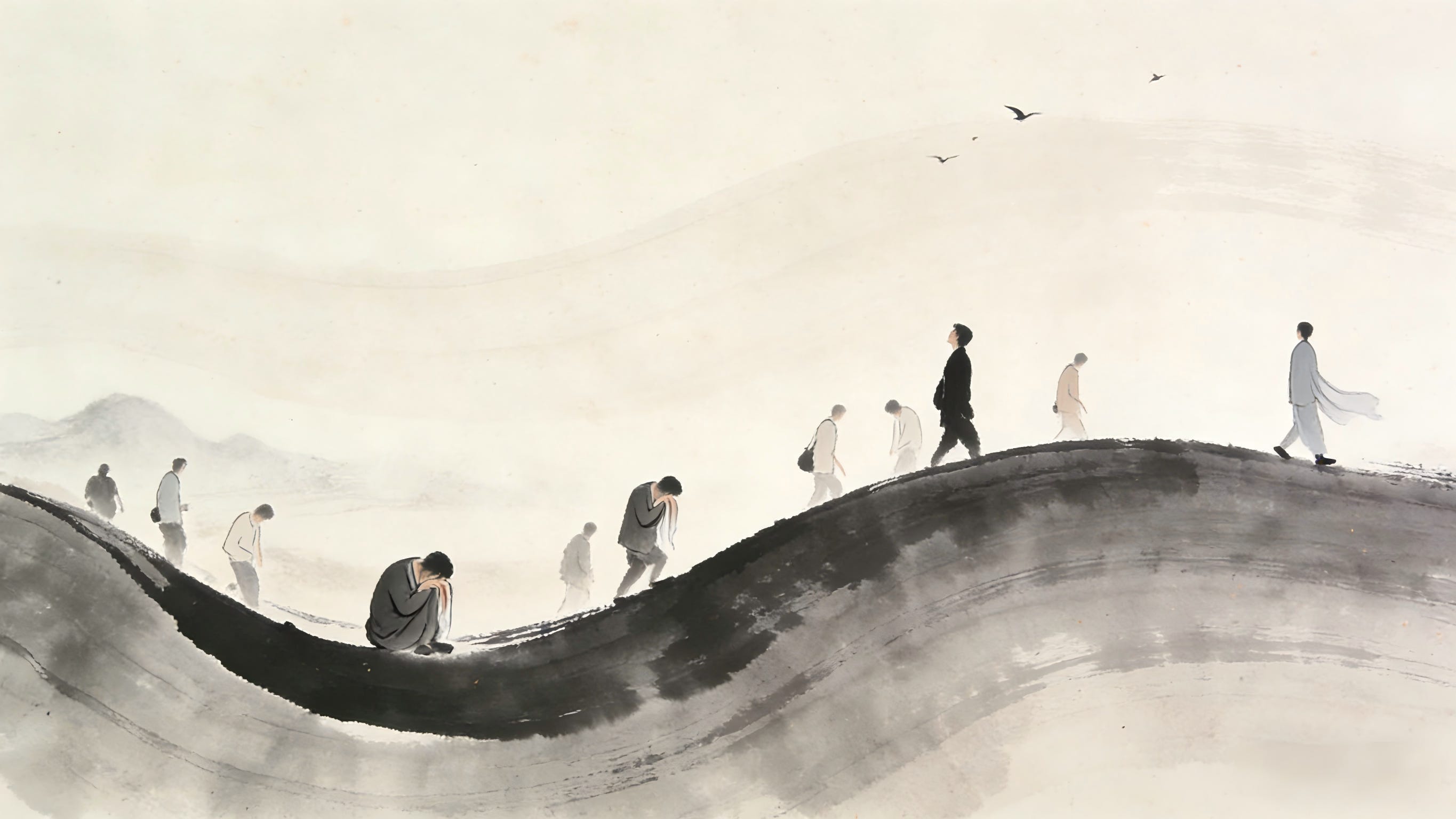
Growth moves in waves. There are periods of visible progress and periods that feel flat or even backward. Those plateaus are not signs that you’re stuck; they are often signs that something is integrating beneath the surface.
The problem arises when we judge ourselves by an idealized standard—believing we should no longer feel bothered, reactive, or uncertain. That standard has nothing to do with real human development. It only creates pressure and discouragement.
Instead of asking,Why am I still struggling? It may be more honest to ask,How am I struggling differently than before?
When you take the time to look back, really look, you may notice that you’re not where you once were. You respond with slightly more patience. You recover with slightly more ease. You understand yourself with slightly more compassion.
These are not insignificant changes. They are the result of steady effort over time.
So don’t let a temporary moment of frustration erase the road you’ve already walked. Don’t use a single emotional wave to invalidate months or years of sincere practice. Progress does not require perfection. It requires persistence and honesty.
Pausing to acknowledge how far you’ve come is not complacency. It’s nourishment. It gives you the strength to continue.
Simply staying on the path, through doubt, through setbacks, through ordinary days, is already an achievement many people never reach.
And every time you return to balance a little faster than before, you are witnessing the most reliable proof of growth there is.
Not the absence of struggle, but the deepening ability to meet it.