

We all have physical pain here and there.
Maybe not today. Maybe not this week. But if we live long enough, pain will visit us. I think nobody can say they will never experience physical pain.
Some of us have already had very intense pain. Some may be dealing with it right now. And even if you feel healthy today, who knows what life brings in a few years? An accident. Illness. Aging. Something unexpected.
Pain is just part of being human.
Usually we see pain as something purely negative.
Something to get rid of. Something unfortunate. Something unfair. Something that interrupts life.
And of course, I understand that. Pain hurts. I’m not trying to romanticize it. I’m not trying to pretend pain is enjoyable or that suffering is somehow automatically noble.
But I do think there is another way to look at it.
Is it possible that pain has a deeper meaning?
Not always. Not in every case. But sometimes?
Is it possible that if we understand and work with pain in a different way, it can actually teach us something useful—physically, psychologically, emotionally, and even spiritually?
Or even contribute to our long-term happiness?
I know this may sound wild, but that’s what I want to explore here: just the possibility.
Not as some guru. Not as someone who has mastered pain. I definitely haven’t. I’m sharing this as someone who is still learning, still practicing, still experimenting, still trying to understand what pain is really showing me.
The First Meaning of Pain Is Telling Us Something Is Wrong in the Body
At the most basic level, pain is a warning signal.
It tells us something is wrong in the body.
Maybe there is inflammation. Maybe there is an injury. Maybe something needs treatment. Maybe the body is telling us to stop and pay attention.
That part is obvious. If you break your leg, the pain is telling you something real. Go take care of it. Go get help. Fix what needs fixing.
But what about the times when we already got the message? What about when you know something is wrong, you’ve already checked it, maybe you even got treatment, but the pain is still there?
A lot of people live like this. Headaches. Back pain. Chronic tension. Symptoms that don’t fully go away. Or one issue improves and then another appears somewhere else.
So then what?
If the pain has already delivered the obvious message, but it remains, is it still just meaningless suffering? Or can it point to something deeper?
Pain could function as a distraction to keep you from feeling some terrible emotions you don’t want to face.
This idea really stayed with me.
I learned a lot from Dr. John Sarno’s work. He points to something important: sometimes pain can function as a distraction from emotions we do not want to consciously feel.
The brain decides that it would be really bad to face some terrible emotions, so it creates pain by reducing the oxygen supply to the local tissues. With less oxygen, pain occurs. And when there is pain to lock your attention, you won’t notice the repressed emotions.
But according to him, once one understands this mechanism and drops the distraction method by being willing to face the emotions, the pain stops.
So what kind of emotions we are so afraid to face?
Rage, shame, guilt, fear, grief, resentment. All the darker feelings that threaten the identity we want to have.
Because if I consciously feel rage toward someone I love, what does that mean about me? If I feel jealousy, guilt, or shame, what does that say about me?
It can feel threatening to our image of ourselves as a good person.
So what do we do?
We suppress, we repress, we push it down.
But what is repressed does not disappear.
It stays there like pressure in a pressure cooker. It wants to be experienced. It wants to come into consciousness. And if we don’t know how to feel it directly, the system may find another route. In this framework, pain becomes a distraction. Attention goes to the body, so attention does not have to go to the repressed emotion.
I’m not saying this explains every pain. But I do think some pain may be saying something more subtle than, “This tissue is damaged.”
It may also be saying:
There is something in you that has not been fully felt.
There is some part of life in you that has been pushed away.
There is an inner backlog that wants to move.
And when that happens, pain is no longer just a physical problem. It becomes part of inner growth too. Because if we keep repressing parts of ourselves, in a way our growth gets arrested. To become whole again, we have to be able to experience what is in consciousness as it is.
Pain Can Help Develop the Skill of Equanimity, Which Reduces the Suffering from Pain.
This is another big way I’ve come to see pain.
In spiritual traditions, people have intentionally worked with pain for a long time.
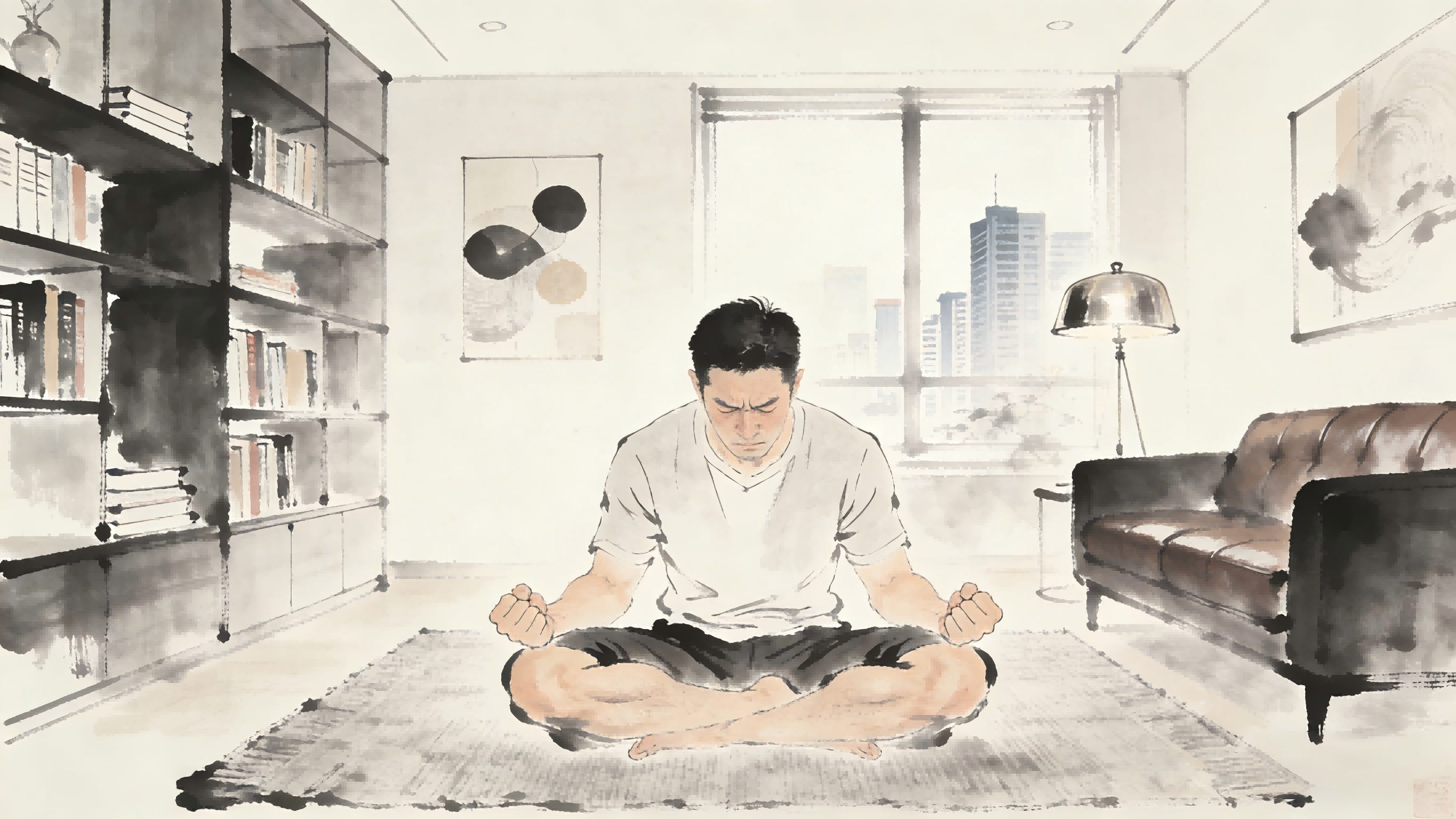
Zen practitioners sit in the lotus position for long periods. This posture can be very painful if maintained for a long time, especially when your legs are not flexible enough. Certain Native American rituals, for example, the Sun Dance, involve physical hardship and piercing.
From the outside, that can look extreme. Why would anyone do that to themselves?
But I don’t think the point is pain for pain’s sake. I think one of the deeper purposes is to train equanimity.
By equanimity, I mean the ability to let experience be there without immediately pushing or pulling.
Not clinging when something feels good. Not resisting when something feels bad.
Just being with what is there.
That sounds simple, but it’s a very deep skill.
Because what makes suffering so intense is often not just the pain itself. It is the resistance on top of the pain.
Here is the formula by Shinzen Young:
Suffering=Pain × Resistance
The mind says:
This shouldn’t be happening.
Why me?
What if this never stops?
I can’t handle this.
And then the body tenses more. Emotion rises. Fear rises. All these are components of resistance. The whole thing compounds.
So in that sense, suffering is not just pain. It is pain multiplied by resistance. And the less resistance there is, the less suffering there tends to be.
When your equanimity skill is trained to a higher level, you have less resistance.
That doesn’t mean pain disappears instantly. It means the relationship to it changes.
And that change helps you suffer less from it.
Higher Equanimity Can Help You Release Repressed Emotions
I’ve had meditation sessions in full lotus where the pain became really intense.
One time I did two sessions with only a short break in between. During the second one, it hurt so much that my body started shaking. It was way beyond comfort. I was not calm and above it all. It was just intense. But afterward, something surprising happened.
I felt lighter.
It was as if some old grief or sadness had been released. I had been working with physical pain, but somehow emotional pain moved too.
Why would that happen?
My understanding is this:
When we work skillfully with physical pain, we are training less resistance. And less resistance doesn’t only apply to physical sensation. It also applies to repressed emotional holdings.
Resistance is basically an attitude. When our equanimity is trained to be higher, we are shifting to the attitude of non-resistance.
So if we become more capable of letting physical pain move through, we may also become more capable of letting grief, sadness, fear, and other buried feelings come to the surface. And once they come to the surface, they no longer need to stay repressed in the same way.
This may also explain why some people temporarily feel worse when they meditate more deeply.
It’s not necessarily that the practice is harming them.
It’s actually because they are just becoming less numb.
They are giving permission for what was buried to rise. And that can feel uncomfortable.
Once the repressed feelings are let go, one immediately feels lighter and even happy for no apparent reason.
Pain Can Even Open a Sense of Spaciousness—a Transcendent State
There is another thing pain can do.
Sometimes, if we approach it in the right way, pain can push us toward a different experience of awareness.
Usually we feel, “I am the one in pain.”
But sometimes there is a shift.
Instead of “I am pain” or “I am trapped in pain,” it becomes more like, “Pain is happening within awareness.”
That may sound abstract, but it is actually very practical.
The image I like is this: you are the sky, and the pain is a dark cloud.
The cloud is still there, the pain is still there, but the sky is larger.
And when identity shifts more toward the sky than the cloud, the suffering changes. Not always instantly, not perfectly, but something opens. The pain is no longer the whole universe. It is something being held within a larger space.
And you suffer less in that state.
I think this is one reason intense spiritual practices have existed for so long. Pain can sometimes push us closer to that direct experience of spaciousness, not as an idea, but as something lived.
Two Practices to Work with Pain to Reduce Suffering
What follows are two strategies I use.
Not as someone who has mastered this, but as someone still practicing.
Sometimes one works better than the other. Sometimes I move between both.
Strategy 1: Escape into pain
This sounds strange at first, but what I mean is this:
Instead of trying to run from the pain, I go into it. I bring my attention closer. I get more intimate with the experience. I stop relating to it as one giant enemy and start exploring it directly.
Step 1: Remember that pain and suffering are not exactly the same
The first thing I remind myself is this:
I’m not only suffering from the pain itself. I’m also suffering from my reaction to the pain.
That reaction includes the fear, the resistance, the mental story, the tension around it.
That reminder helps me separate raw sensation from the extra suffering I’m adding to it.
Step 2: Notice the thoughts around the pain
Before going deeper into the body, I notice what the mind is doing.
Usually the mind is spinning some kind of fear story or future story.
So I just notice thoughts like these:
What if this gets worse?
What if this never goes away?
Why is this happening to me?
I can’t take this.
Not trying to force it away. Just seeing it more clearly.
That already gives me a little more space.
Step 3: Let the emotional reaction be there too
Pain often comes with emotional reaction.
Fear, anger, helplessness, irritation, and sometimes even sadness.
So I try not to only focus on the physical sensation. I also allow the emotional reaction to be there.
Not fixing it. Not suppressing it. Just letting it be part of the moment.
Sometimes the emotional layer is sitting in the body too, tightness in the stomach, contraction in the chest, agitation in the system. Letting that be there is part of the practice.
Step 4: Turn toward the raw sensation itself
Then I gently bring attention into the actual pain.
Not in an aggressive way. More in a curious way.
I ask:
What is this really made of? Is it burning, tightness, pressure, throbbing, stabbing, pulsing, or heat?
Step 5: Break the pain down into smaller pieces
This part helps a lot.
Instead of relating to the pain as one overwhelming thing, I look more carefully.
Where is the center?
Which part is most intense?
Is there a softer edge around it?
Does it stay still or move?
Does it come in waves?
Sometimes there is a very intense center, but there is also a less intense periphery around it. Sometimes I move attention between the center and the outer area. That way I’m still with the pain, but I’m not fixated only on the sharpest part. The more detail I notice, the more present I become, and the less overwhelmed I usually feel.
Strategy 2: Anchor away on spaciousness
Sometimes going into the pain helps.
But sometimes the pain is too intense, and going deeper into it is just too much.
In those moments, I use a different strategy. Instead of moving closer to the pain, I anchor attention somewhere else — in spaciousness.
Step 1: Widen the field of attention
I stop focusing tightly on the pain and start noticing space.
The space in the room, the space around objects, the space above me, the space behind me, and surrounding my whole body.
It helps to open the eyes and really notice the room or the space outside the window. Usually we notice objects first, but here I try to notice the space holding the objects. Then I let the pain be just one thing happening inside a much bigger field.
Then I may close my eyes and feel the infinite dark space all around me. It’s a blend of imagination and a felt sense.
Step 2: Rest as the larger awareness
From there, I try to feel that awareness itself is bigger than the pain.
The pain is happening, but it is happening within awareness.
That subtle shift can make a big difference.
Instead of feeling like I am trapped inside the pain, it starts to feel like the pain is being held by something larger.
That “something larger” gives me room to breathe.
I move between both
So for me, these are the two main ways I practice with pain:
One is to go into it. The other is to open beyond it.
One is intimacy with sensation. The other is anchoring in spaciousness.
Sometimes the right move is to get closer. Sometimes the right move is to zoom out.
I don’t think this is about following a rigid method. It’s more about sensing what the moment needs.
And underneath both strategies is the same deeper practice: a little less resistance, a little more openness, a little more willingness to let the moment be what it is.
Why This Matters Beyond Physical Pain
To me, this is not just about pain. This is about life. Because life keeps bringing things we do not want: disappointment, fear, aging, sickness, uncertainty, loss, emotional pain, and situations we cannot control.
And usually the instinct is the same: contract, resist, fight reality.
But reality does not always listen.
So at some point, the deeper question becomes: can I meet this moment with a little more equanimity? A little more surrender? A little less inner friction?
That is why I think pain can become a teacher.
Not because pain is good in itself. But because pain gives us a place to practice a way of being that helps with all of life.
The willow tree survives the storm because it bends. If it were rigid, it would break. There is wisdom in that.
I’m Still Learning This Too
I’m not beyond resistance.
I still resist pain.
I still tense up.
I still get lost in thought.
I still don’t enjoy pain.
But I’ve seen enough to believe this: Pain is not always just an enemy.
Sometimes it is a message.
Sometimes it points to buried emotion.
Sometimes it trains equanimity.
Sometimes it helps emotional release.
Sometimes it opens a more spacious awareness.
So I don’t think we should glorify pain. But I also don’t think we need to see it only as meaningless bad luck.
Maybe pain is one of life’s hardest teachers.
Not one we would choose. But still, a teacher.
And if pain is inevitable, then maybe one of the wisest things we can do is learn how to work with it, not just so we suffer less, but so we become a little more whole in the process.
Another great post! Thank you