

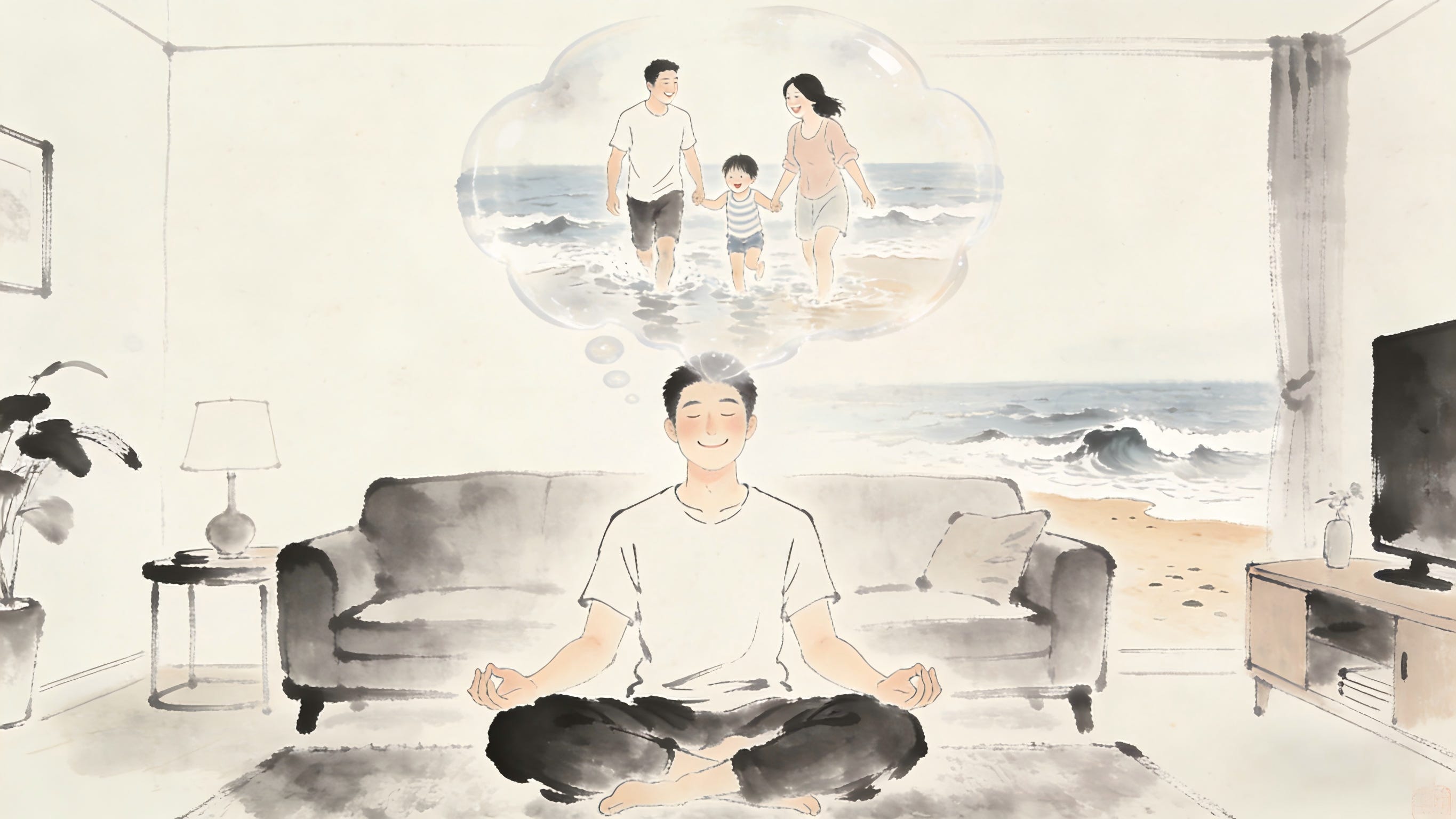
Have you ever noticed this quiet assumption running in the background of your life?
Once I make enough money, then I’ll be at ease. Once I have the right relationship, then I’ll finally be happy.
Without realizing it, we place happiness just one step ahead of where we are. It becomes something conditional, dependent on external milestones we haven’t yet reached. And so we keep moving, striving, adjusting ourselves to meet the world’s definition of success, while a subtle fatigue builds beneath the effort.
In the midst of all that movement, we often miss a simple truth: the feeling we call happiness does not originate outside us. It arises within us.
We build a dam to stop happiness from flowing to us in our psyche. And we set the happiness standard: only if I make enough money or have the right relationship, can that dam be opened and happiness flow to me.
Laozi captured this insight thousands of years ago in a single line from theTao Te Ching:“One who knows contentment is rich.” True wealth, in this sense, has nothing to do with accumulation. It comes from inner sufficiency—a quiet sense of enoughness. And that inner sufficiency is the soil from which happiness flows.
Those who “know contentment” are those who realize that we don’t have to hold the happiness standard so high. We are free to let it go and experience our intrinsic well-being.
In Unified Mindfulness, there is a simple practice called Feel Good. Its purpose is not to chase pleasure or escape reality, but to help us reconnect with the well-being that already exists beneath our mental noise.
The practice is uncomplicated and accessible, something you can do in the morning before the day pulls you outward, or at night when everything finally becomes quiet again.
You begin by gently imagining a scene that represents ease or fulfillment for you. Perhaps it’s financial security—having enough money to feel relaxed, waking up without anxiety, making coffee slowly in the morning, walking through the evening without urgency.
Or perhaps it’s a relationship that feels safe and nourishing, where you are accepted as you are, where joy and difficulty are shared rather than carried alone.
The scene itself doesn’t need to be realistic or detailed. Its only purpose is to evoke a pleasant, settled feeling.
Once that feeling appears, you let your attention rest there. You notice how it expresses itself in the body. It might feel like warmth in the chest, a gentle sweetness in the heart, or a soft release of tension in the shoulders. There is no need to hold onto it tightly, and no need to worry about losing it. You simply stay with it, allowing it to rise and fall on its own.
If you also sense negativity in you, just don’t resist it; let it be there in the background of your mind.
When the feeling fades, as all sensations do, you can return to the imagined scene and let it arise again. There is no forcing involved. The practice moves at the pace of your nervous system, not your willpower.
It’s important to be clear about what this practice is not. It is not a technique for manifesting external outcomes. You are not trying to make the imagined scenario come true through visualization. The purpose is far simpler and far deeper than that.
This practice reminds us that peace and happiness are not created by circumstances. They are capacities of the mind and body. For many of us, these capacities have simply been buried under layers of stress, desire, and constant striving. The Feel Good practice doesn’t add anything new; it gently removes the dust that has settled over something already present.
In other words, we are not practicing in order to get happiness. We are practicing to recognize that happiness has never left.
Laozi warned that “there is no greater misfortune than not knowing contentment.” Our endless pursuit of more, more success, more validation, more certainty, often comes from a sense of lack. Ironically, this pursuit is what obscures the very happiness we’re seeking. Desire becomes so loud that we can no longer hear the quieter voice of inner sufficiency.
If one day the imagined scenario you practice with happens to materialize in real life, that is simply a side effect. A pleasant one, perhaps, but not the point. External conditions are always changing. Money is spent. Relationships changes.
Life shifts in ways we cannot control. To anchor our happiness in what is impermanent is to guarantee future disappointment.
Inner peace, by contrast, does not depend on favorable conditions. It is like a home we can return to, regardless of what the world is doing.
This is why, in this practice, the practice itself is the destination. The moments of ease, the gentle companionship with your own inner life, the experience of resting without striving, these are not stepping stones toward happiness. They are happiness.
As you spend more time here, something subtle begins to change. You may notice that you no longer feel compelled to prove your worth through achievement. You may feel less desperate for external reassurance. You may begin to trust that your capacity for joy does not depend on becoming someone else or reaching some distant goal.
The deeper realization is simple, but profound: unconditional well-being is already complete within you. You do not need to chase it. You do not need to earn it. You only need to stop overlooking it.
The next time you feel anxious or low, you might try this practice, not as a way to fix yourself, but as a way to be with yourself. Sit with a pleasant feeling for a few quiet moments. Let it come and go without expectation. In doing so, you may discover that happiness has never been something you had to reach for.
It has always been a place you could return to.